
Most North Korean Refugees Are Women. Here’s Why.

Over 33,000 North Korean refugees have made it safely to South Korea. 70% of them are female.
Why?
Firstly, North Korea is both politically and culturally very patriarchal, so women traditionally have a lower status than men, and are actually less tightly controlled by the North Korean system. Starting from the famine of the 1990s, North Korean women had to exploit their official status as “housewives” to engage in private market activities and become the breadwinners to ensure their family’s survival.
This combination of a new found economic role, relatively more mobility, and increased independence led more North Korean women to seek further economic opportunities in China (sometimes with an intention to stay temporarily and return, and sometimes as a more permanent move).
There was also a perception among North Koreans that women would have a better chance of being able to stay under the radar and work informally in China, for instance in restaurants or textile factories. This has in fact been borne out in reality, and there is another more tragic factor pulling North Korean women into China—a demand for North Korean brides among unmarried Chinese men, and a broader demand for North Korean women in the Chinese sex industry (including brothels and online sex chat rooms). This demand is driven by a lack of marriage-aged women particularly in rural Northeast China, a result of China’s ‘one child policy’ and the migration of young Chinese women to the cities.
Regardless of the reason behind their initial escape into China, a higher proportion of women getting out of the country translates to a female majority making it all the way to South Korea.
Another reason that might be thought to hold North Korean men back is that they are tied up in military service for much of their 20s, which is a prime age for defection. Not only do men have less freedom when they are in the military, but they are also often relocated to the interior of the country away from the border with China, decreasing their chances of escape. However this does not exactly play out in the demographic data for arrivals of North Korean refugees in South Korea, which shows no spike in the female to male ratio of refugees in their 20s, so it is hard to say how big of a factor this is.
Finally, anecdotally, it seems that some North Korean women may be more likely to be motivated to make the journey to South Korea after watching dramas and films that are smuggled into North Korea on USBs and Micro-SD cards. North Korean women have told us that visions of life in South Korea where women have much greater freedom in self expression and fashion, and are granted higher status and respect—especially by the romantic heartthrobs of your typical K-drama—fueled their fantasies of life beyond North Korea’s borders and were a significant factor in their decision to escape.

Among the more than twenty thousand female North Koreans who have made it all the way to safe resettlement in South Korea have emerged some of the most effective advocates for the North Korean people. Several North Korea-born women have written books, and are increasingly giving the issue a human face on South Korean television and to audiences around the world.

These advocates, and hundreds of other North Korean women who have quietly strived to successfully resettle and bring their children and other family members to South Korea, are among the people that we’ve been able to support and work with because of your commitment to stand alongside the North Korean people.
So on International Women’s Day, we salute the North Korean women who have been able to emerge as a force of progress despite being born in the most repressive country in the world, and we salute our sisters and brothers around the world who continue to believe in and support them.
- Sokeel Park, Director of Research & Strategy
Spring in My Homeland, North Korea: A Glimpse of Reunification in 2045
By: Eunsook Jang
Eunsook Jang holds a bachelor’s degree in Political Science from Korea University and a master’s degree in International Development from Brandeis University. A Fulbright Scholar and LiNK US Scholarship grantee, she is currently a research intern at the Hudson Institute, where her work focuses on post-conflict recovery, economic development, and human development. Her recent publications include “Slipping through the Cracks in South Korea: The Uncertain Futures for the Children of North Korean Defectors” with the Migration Policy Institute, and “Why Strengthening RFA Is a Strategic Imperative for US Policy on North Korea” in The Diplomat.
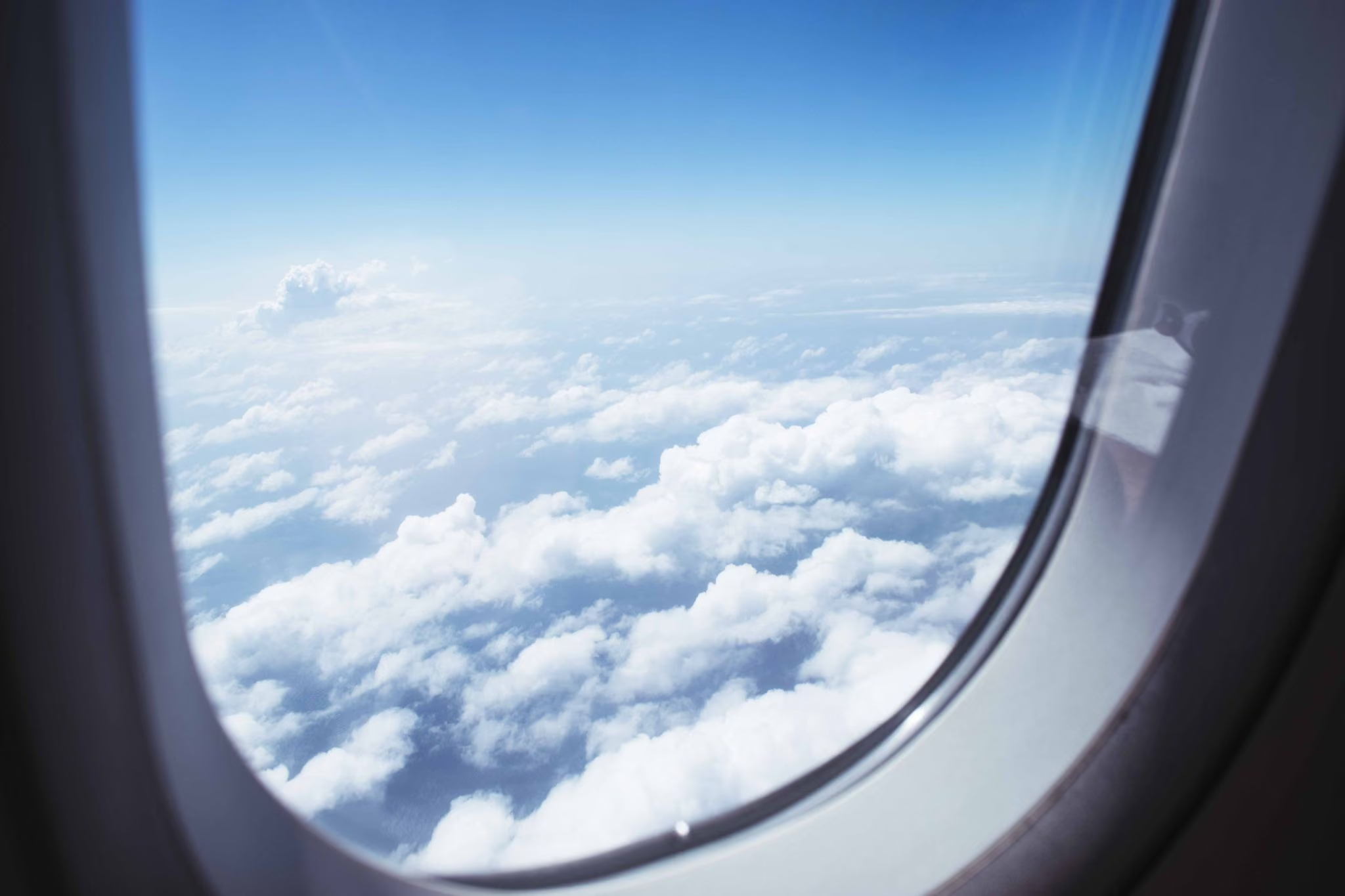
In the spring of 2045, on a flight from Incheon to Pyongyang, Emma's hands tremble. Her husband Sam reaches over and, steadily, holds them without a word. She turns to the window and stares into the pale clouds below the wing.
“I’ve waited 30 years for this day,” she whispers. “But now that I’m here… it doesn’t feel real. I hope this isn’t a dream.”
“Maybe it’s both,” Sam replies. “The dream became real.”
She closes her eyes. In 2015, at just fifteen years old, she crossed the frozen Yalu River in a dark March morning, leaving without saying a proper goodbye to her mother. That guilt, its intensity, has never faded, not even after thirty years. It simply learns to live quietly beside her.
“Will Mom recognize me?” she asks. “We parted when I was fifteen. I’m forty-five now.”
“She will,” Sam answers. “How could a mother not recognize her daughter?”
Emma says nothing. Will I... be able to recognize her? She does not say it aloud this time.
An announcement comes through the cabin speakers: "This is the first return flight for North Korean defectors to their hometowns. We know how much you have endured. We will carry you safely home."
It is a rare moment of comfort from a South Korean voice. Moments later, the plane lifts into the sky.
An hour later, the plane lands in Pyongyang. Emma weeps quietly, overwhelmed by the thought that across so short a distance, lives in the South and the North had been so utterly, irreconcilably different. For thirty years, she had not been able to cross it, that gap, so small.
From Pyongyang, the journey to Hyesan continues by bus. As the skyline of Pyongyang passes past the window, its taller buildings, its broad avenues, Emma allows herself the fragile hope: perhaps Hyesan has developed too.
After five hours on the road, the bus arrives at Hyesan Station. The apartments and the lay of the land are almost entirely unchanged from when she had left thirty years earlier, as if time had refused to move, as if it had been waiting for her. Emma found herself hoping the same might be true of her mother.
A thirty minutes' walk from the station: that is where her mother's house is.
As if drawn by a magnet, her feet start moving on their own.
Sam asks if they are going the right way. Without hesitation, "Yes," Emma replies. "I used to walk this road every day as a child. It’s still in my body."
He points to a bus queue down the street. "There's a bus queue over there. Want to take it part of the way?" She shakes her head gently. "If you don't mind, I'd like to walk." "Then we’ll walk," he replies without hesitation. Emma feels another surge of gratitude, grips on his arm and follows her memory home.
Since Emma left her hometown in 2015, the North Korean regime has conducted ten more nuclear tests as of 2045. And yet the face of this neighborhood has not changed by a single detail. The freedom and human rights that should have been the people's return on those tests have been vaporized into the air.
They arrive at a fork in the road. To the left, an alley leads toward the house. A familiar-looking house comes into view, enclosed by a wooden fence. She stops and stands motionless. It is the house, it is her house.
Several minutes pass. Then the door opens. Emma feels her breath catch. For a second, she forgets how to move.
After thirty years, she is here.
This is what the micropolitics of reunification looks like. Grand narratives, speeches, and legal texts may provide its official language, but its lived realities lie in moments, in feelings, like this: a mother and daughter recognizing each other after thirty years apart.
Author’s note: I dedicate this piece to my father in South Korea, who has never once wavered in encouraging my studies, as if realizing through me the freedom to pursue the dreams that were taken from him. And to my mother, who remains in North Korea: This piece is my proof that your daughter has not turned away from your suffering, but is working, in her own small way, to fight against it. I hope to see you, even if only in my dreams tonight. I love and miss you beyond my expression.
–
Eunsook is a participant of the LiNK English Language Program (LELP), which serves to not only help North Korean defectors build confidence and skills in English, but develop their capacity as advocates for this issue. To that end, we partnered with select LELP “columnists” to write and polish personal essays through multiple rounds of external feedback and revision. Our goal is to have more North Koreans share their stories directly and lead efforts to change the narrative.
We believe the North Korean people can achieve their liberty in our lifetime.
Opportunities like LELP invest in the people building that future now. Help more North Koreans find their voice, reach their goals, and lead change on this issue.










