North Korean Defector Economist: How We Analyze North Korea Needs to Change
By: HyeGyeong Joo
HyeGyeong is a PhD student in the Department of Economics at Korea University, specializing in theoretical economics. Her research looks at developing theoretical models of the North Korean economy. Since 2022, HyeGyeong has also participated in LiNK’s English Language Program.
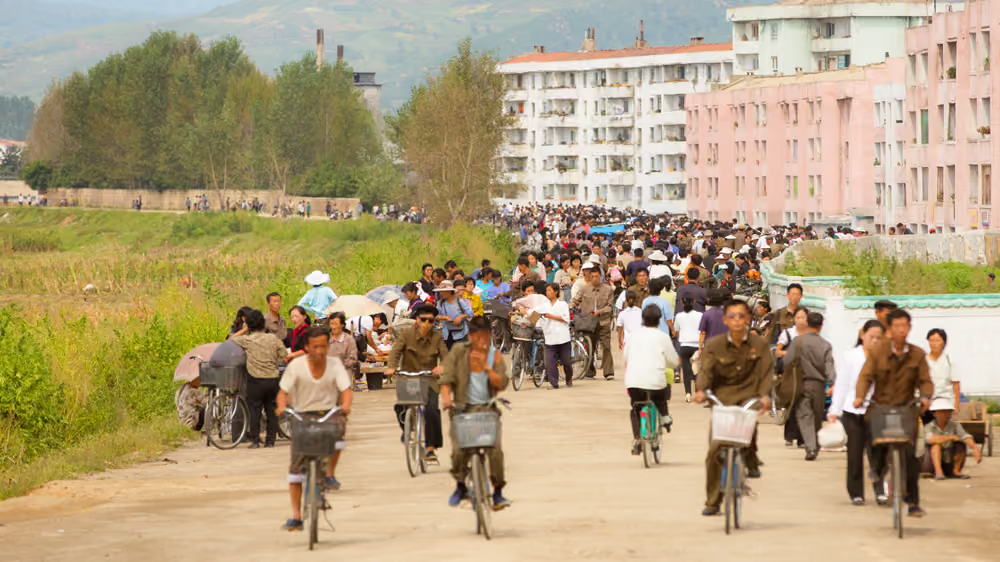
When I think about my past, I often feel a great sense of loss and sorrow for the people I left behind in North Korea. As a PhD student studying North Korean economics here in South Korea, I feel a strong desire to use my research to help improve the lives of North Korean people. In many ways, helping those I left behind also gives meaning to my own journey.
Whenever I watch the news or read academic papers on North Korea, I feel saddened by the way North Korean people are discussed and represented. Over time, I have come to believe that the way we analyze North Korea needs to change.
I believe there is a fundamental limitation in existing research on the North Korean economy, as much of it has traditional socialist planned economy analysis. Earlier studies have suggested that North Korea would either collapse or undergo a system transition as other socialist countries have done. However, after the breakdown of the Public Distribution System (PDS) in the mid-1990s and the emergence of the shadow economy (including through the Jangmadang—illegal markets), these approaches began to reveal their limitations.
As a result, the North Korean economy came to be understood not as a simple planned economy, but as a mixed economy in which state control and market activities coexist. However, these studies do not sufficiently explain why the North Korean regime allows marketization to persist at a certain level instead of completely suppressing it.
In order to explain the interaction between the government and ordinary North Korean citizens, who are the primary actors in Jangmadang activities, I divide the North Korean system into three groups: the regime, the elites, and ordinary citizens.
In particular, elites are important economic actors because they function as intermediaries between the regime and the people. My argument is that this phenomenon can be better understood by analyzing how these three groups strategically interact with one another.
These three groups pursue their interests in different ways, and their goals also differ significantly. The leadership wants to continue dynastic rule and ensure stable succession, the elite seek to secure their positions and avoid political risks such as purges, and ordinary citizens primarily seek survival and improved living conditions.
The interests of these three groups sometimes conflict with one another and sometimes align. In my opinion, these three groups in North Korea are currently remaining in a state of equilibrium.
This equilibrium means that these three groups can achieve their maximum interests under the current conditions in North Korea. Precisely because of this equilibrium, North Korea has been able to maintain both regime stability and limited marketization simultaneously.
That is why I believe we must identify what kind of shocks could cause this equilibrium to collapse. If such a change were to occur, it could become a new turning point for North Korea.
A new turning point for North Korea could lead the country toward a new political and economic order. The important thing is that we must identify what kinds of shocks could trigger such a transformation.
I hope for a North Korea that has changed—a place where its people can live freely. For me, North Korea is not just a state; it is my hometown, where I was born and raised, and where my family still lives. This is precisely why I am committed to a different approach to the North Korean issue—because my only goal is to see genuine change in North Korea, and I truly want to help bring about that change.
I want my article to inspire you to see something different the next time you watch the news or media coverage about North Korea. The next time you come across a piece of media about North Korea, I hope you take a moment to think about the real North Korean people. And perhaps you may also reflect on this article and consider what kinds of shocks could transform the current equilibrium of North Korea.
I hope you will join me on this journey.
–
HyeGyeong is a participant of the LiNK English Language Program (LELP), which serves to not only help North Korean defectors build confidence and skills in English, but develop their capacity as advocates for this issue. To that end, we partnered with select LELP “columnists” to write and polish personal essays through multiple rounds of external feedback and revision. Our goal is to have more North Koreans share their stories directly and lead efforts to change the narrative.
We believe the North Korean people can achieve their liberty in our lifetime.
Opportunities like LELP invest in the people building that future now. Help more North Koreans find their voice, reach their goals, and lead change on this issue.
Give Today
At the Forefront of North Korean Human Rights Work | LiNK Organizational Update
Liberty in North Korea welcomes Sarah Yun as our new Chief Regional Officer (CRO), South Korea, as our previous South Korea Country Director, Sokeel Park, transitions into a new role as our Chief Strategy Officer (CSO). Sarah and Sokeel will collaboratively lead LiNK’s South Korea operations while growing LiNK’s impact through their respective areas of expertise.
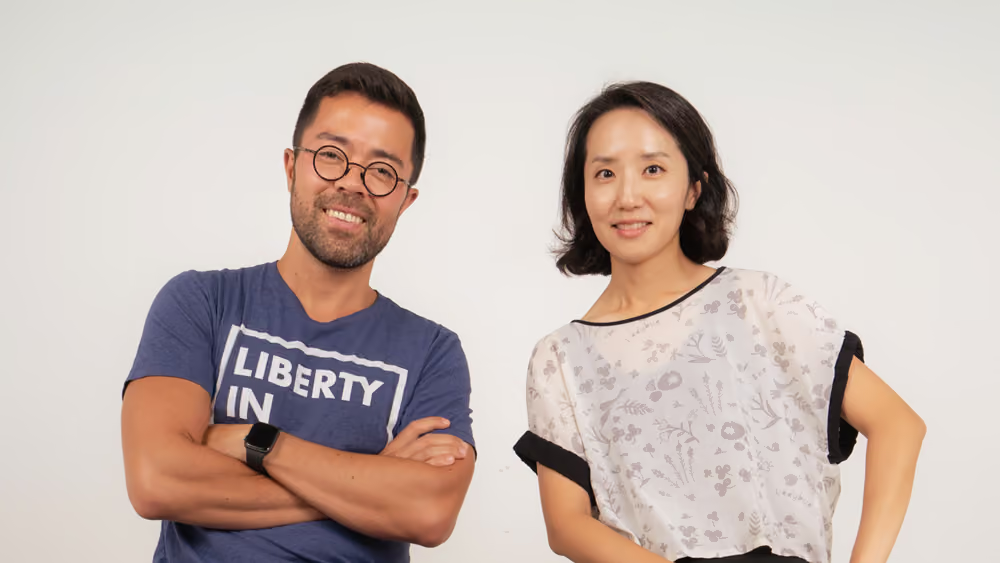
Over a Decade of Dedication to Human Rights
Sarah Yun brings a wealth of experience and expertise from her work to advance human rights in North Korea and across Asia during the past 15 years. She most recently served as the Country Director of Korea and Cambodia at the National Democratic Institute (NDI), managing the Institute’s operations and programs in the two countries.
Previously, Sarah was a Senior Manager for Asia at the National Endowment for Democracy (NED), overseeing the Cambodia, Vietnam, North Korea, Thailand, and the Philippines programs and teams. Prior to her experience at the NED, she worked at the Center for International Private Enterprise where she managed the Cambodia and North Korea programs, in addition to the Papua New Guinea program and field office.
“I have had the opportunity to work on issues related to various countries in Asia at a variety of institutions throughout my career, but my greatest passion has always been to envision a North Korea where its people can choose their own future. I am deeply inspired by the stories and resilience of the North Korean people and am committed to supporting their leadership and efforts toward a better future.”
– Sarah Yun, LiNK CRO
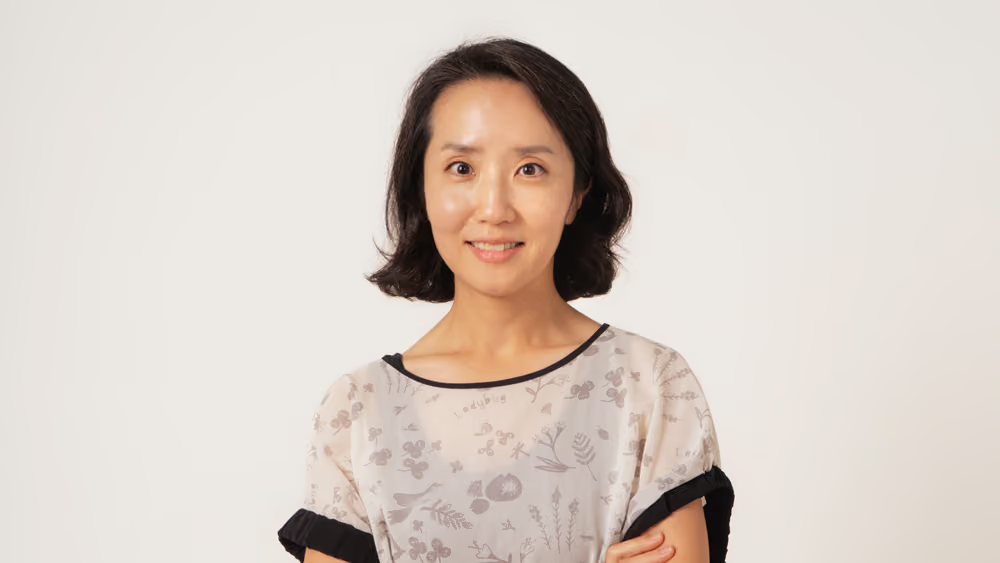
Sarah holds a BA in Political Science and Business Institutions from Northwestern University and MA in International Relations and International Economics from Johns Hopkins University School of Advanced International Studies. Her journey with LiNK began in college, when she came across her campus LiNK Team.
“I first learned about LiNK during my college years, when chapters began to emerge across the United States. Since then, I have respected the organization’s mission and work. When I was given the opportunity to work at LiNK, I had great anticipation and excitement at the thought of joining and supporting North Koreans' journey toward a free and open future. Together with the LiNK team, I hope to contribute to amplifying the leadership and voices of young North Korean defectors in creative and impactful ways.”
– Sarah Yun, LiNK CRO
A Strategic Shift
As LiNK continues to expand and refocus our programs in response to the evolving needs of this issue, there was a timely opportunity to bring on Sarah and diversify the organization’s impact.
As CRO, Sarah Yun will lead LiNK’s South Korea team, oversee our Capacity Building Programs, and represent the organization in South Korea. Sokeel Park will jointly represent LiNK alongside Sarah and maintain key collaborative efforts with external stakeholders. As CSO, Sokeel’s scope will also encompass the development of the organization’s broader strategy and Information Access Programs (IAP). Moving forward, IAP is an area of work which we are expanding as a crucial way to support North Koreans driving change inside the country, and achieve our vision.
North Korean refugees consistently tell us that getting more outside information into North Korea is crucial for empowering North Koreans to change their country. The importance of this area of work has only increased in recent years, so it is vital that we are able to increase the resources and time we are investing into these strategies. I’m extremely grateful to our donors for joining with us and making this expansion and these initiatives possible.”
– Sokeel Park, LiNK CSO
This is a challenging time for North Korean people, refugees, and the issue. We are grateful to Sarah for bringing her experience and expertise to LiNK and everyone whose support sustains our organization and enables us to grow.
We look forward to increasing our impact with Sarah’s leadership and sharing updates about our progress with our supporters.