SONGBUN | Social Class in a Socialist Paradise

The history of all hitherto existing society is the history of class struggles.
Freeman and slave, patrician and plebeian, lord and serf, guild-master and journeyman, in a word, oppressor and oppressed, stood in constant opposition to one another, carried on an uninterrupted, now hidden, now open fight, a fight that each time ended, either in a revolutionary reconstitution of society at large, or in the common ruin of the contending classes...
The modern bourgeois society that has sprouted from the ruins of feudal society has not done away with class antagonisms. It has but established new classes, new conditions of oppression, new forms of struggle in place of the old ones.
So begins Chapter 1 of The Communist Manifesto, written by Marx and Engels and published in 1848. If we take the last paragraph, and change a couple of labels, it perfectly describes North Korea today:
The North Korean society that has sprouted from the ruins of the division of Korea and the Korean War has not done away with class antagonisms. It has but established new classes, new conditions of oppression, new forms of struggle in place of the old ones.
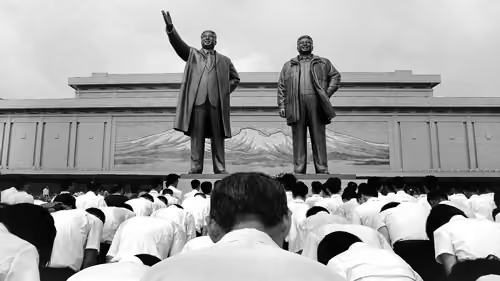
In fact, the North Korean regime has established 3 new classes divided into 51 categories, and has created what is widely recognized as the most oppressive society in the world. Maybe Marx rests easier now that his portrait no longer adorns Kim Il-sung Square in Pyongyang; it was taken down before Kim Il-sung’s centenary celebrations in April. The North Korean regime has been extremely intentional at creating and enforcing social classes based on political loyalty and this system, known as songbun (성분), is key to understanding North Korean society as a whole and specifically and the system of oppression which the ruling elite uses to maintain political control. So a new report on Songbun by our colleagues at HRNK, Marked for Life, is a great addition to the literature on NK.
The report describes songbun as a state-directed system of discrimination based on hereditary classes determined by perceived loyalty to the regime. It decides your prospects in almost every area of life, including education, occupation, military service, Party membership, treatment by the criminal justice system, housing, medical treatment, marriage, and even food supply. The individual has no control over this system, their songbun being decided by their family line, making it analogous to discrimination along racial lines. The whole system can be described as a political apartheid, reminiscent of the racial apartheid in South Africa that attracted such international criticism until it ended with the election of Nelson Mandela.
CREATION OF SONGBUN
The songbun system was devised in the early years after the formation of North Korea out of a motivation to protect the Kim regime by isolating and controlling perceived internal political threats. It did this by categorizing every single North Korean resident according to how politically safe or risky they might be. The key factors considered were your ancestors’ socioeconomic background at the time of liberation (1945), their activities during the Korean War (1950-1953), and whether you had relatives in South Korea or China (being connected to the outside world is bad for your songbun).
North Koreans were split into three broad classes:
- Core (핵심), 28% of the population. Includes professional revolutionaries, descendants of ‘war heroes’ who died working or fighting for the North, peasants or those from peasant families.
- Wavering (동요), 45%. Includes people who had previously lived in South Korea or China, those with relatives who went to the South, families of small-scale merchants, intellectuals, practitioners of superstition, etc.
- Hostile (적대), 27%. Includes descendants of landlords, capitalists, religious people, political prisoners, those who had assisted South Korean forces during the Korean War, or were otherwise judged anti-Party or associated with external powers.
The regime keeps a file on every single person above the age of 17 (before that age your details were registered on your parent’s file), and an incredible amount of work goes into creating and regularly updating these records. The data is now managed using the software system “Faithful Servant 2.0.” This digitization makes it easier for authorities to access any citizen’s songbun file from any Ministry of Public Security computer terminal from provincial to county levels.
EFFECTS OF SONGBUN
Songbun is deeply entrenched in North Korean society and affects nearly all aspects of a North Korean’s life, including (see HRNK’s full report for further details):
Occupation:
In NK, you do not choose your job. The regime chooses it for you, and it is heavily influenced by your songbun. Simply put, if you have low songbun, you will be put into gruelling manual work, whereas if you have high songbun, you might expect a relatively cushy Party cadre position. There is no element of meritocracy here and ability does not factor in much, meaning that it is quite possible that more able workers are placed in less important roles while less able workers are given positions of responsibility. This failure to efficiently utilize their national talent-pool is yet another reason why North Korea’s state-controlled economy struggles so much.
Education:
Again, this is not meritocratic. If your parents have good songbun, then you are allowed to progress. Otherwise, no matter how hard you study, you will not advance academically. As you can imagine, this can cause resentment (although that resentment is sometimes aimed at the parents, not the regime). This system also ensures that “elites play together.” Those with good songbun go through the same schools and the same colleges, and they network within this pool for their future mutual benefit. Those with bad songbun are of course denied such opportunities. The importance of personal connections in North Korean society compounds the importance of songbun.
Family:
Knowing the importance of keeping a clean record in NK society, parents impress on their children the importance of not doing anything to step outside the Party line, as it would affect the whole family. The importance of songbun also means it is one of the most important factors to consider when finding a spouse. If you marry someone of lower songbun you and your children will lose out, so people tend to marry within their songbun level, as indicated by the occupation and status of their partner’s family. (Note that these phenomena are not unique to North Korea, as people tend to marry within their own social class in other countries too. What is unique in North Korea is how this is being played out within a class system which has been systematically created according to the interests of the ruling elite.)
Internal Exile:
For decades, the regime has systematically exiled tens to hundreds of thousands of low-songbun political undesirables to isolated and unfavourable mountainous areas in the northeast of North Korea. Here they have been forced into hard labour, subject to tighter controls, excluded from population centres, and effectively removed as a potential political threat. It could be argued that the regime has not only tried to cut off the outside world but is now increasingly cutting off Pyongyang from its outer provinces, leaving those who are judged as potential political threats isolated and with no way to demonstrate their frustration without risk of complete elimination.
Food:
Songbun has a huge effect on a North Korean citizen’s food supply. Particularly at times of scarcity, the distribution of food and resources has been concentrated to the higher songbun levels - Pyongyang and central regime institutions (Party, government and military). This was particularly noticeable during the famine of the 1990s and the chronic food shortages that have blighted the people ever since. When the state-economy collapsed and there were not enough provisions to go round, the regime stopped providing food to the politically undesirable northeast regions, so the famine hit those regions the hardest. It has been reported that as many as 30% of the population died in the worst affected regions, particularly North Hamgyeong Province. It should come as no surprise then that around 60% of North Korean refugees who have made it to South Korea are also from that province. An issue for another post is how this demonstrates the inextricable linkage between human rights and humanitarian / economic issues in North Korea. Understanding songbun should call us to question the wisdom of distinguishing between “economic migrants” and “political refugees” when it comes to this population.
Medical Care:
The public health system all but collapsed in the 1990s, but special treatment is still available for elites in Pyongyang. People of lower songbun cannot access these facilities, even if they have independent wealth, and the best they can hope for is to buy medicine on the black market.
In short, songbun institutionalizes the dominance of the ruling elite and their descendants over all other groups in society, and as this system has been implemented over several decades, the privileges of the core class have grown while the others suffered.The operation of this system is not at all transparent but people are generally aware of it, although they may not know details, including of their own songbun. Quite a few of the North Korean refugees that I have interviewed about their songbun have not been very sure about their own level. People of higher songbun are better aware of the system, and one gentleman that I interviewed jokingly half-boasted to me that his family was “totally red, the core of the core.” To him it was clear that he had good songbun because so many of his relatives held positions of responsibility within regime institutions, and some members of his family had also been granted considerable educational opportunities.
It is worth noting that while it is extremely difficult to improve your songbun, you can easily drop levels if you get in trouble through committing criminal or political offenses, or fail to cooperate with regime officials, or if a family member gets into such trouble. The implementation of songbun therefore creates considerable fear and forces people to obey the regime, and in reality it is an effective tool used by the regime to maintain control and power.
As we might expect, the changes inside North Korea over the last 15 years have affected the implementation of this system, albeit without being able to overturn it. The interaction between marketization and songbun (both mitigating and exacerbating effects), songbun’s effect on anti-regime sentiment, and the extent to which the songbun system can constrain change in North Korea will be covered in the next blog post…

SOKEEL J. PARK | Research & Policy Analyst
North Korean Defector Economist: How We Analyze North Korea Needs to Change
By: HyeGyeong Joo
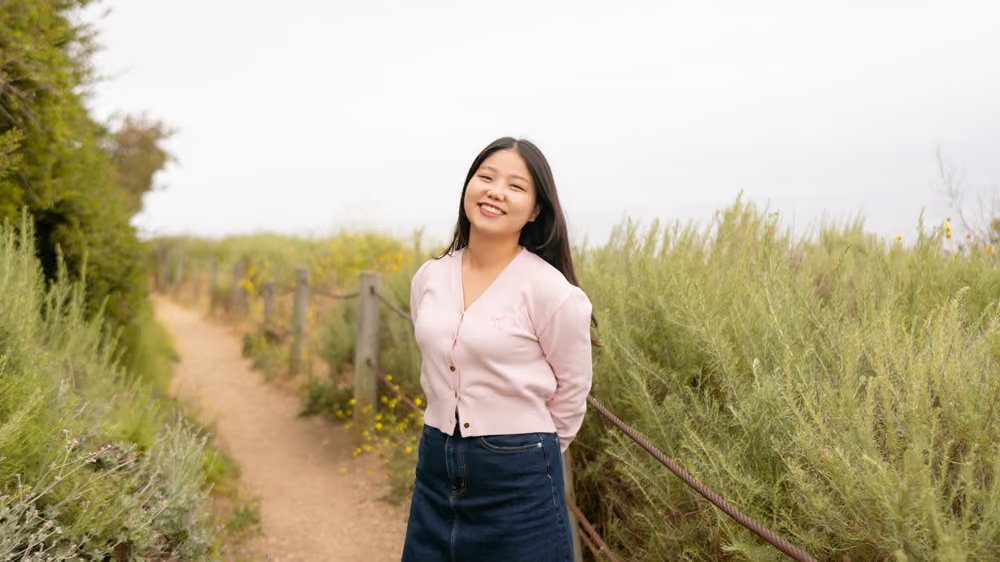
HyeGyeong is a PhD student in the Department of Economics at Korea University, specializing in theoretical economics. Her research looks at developing theoretical models of the North Korean economy. Since 2022, HyeGyeong has also participated in LiNK’s English Language Program.
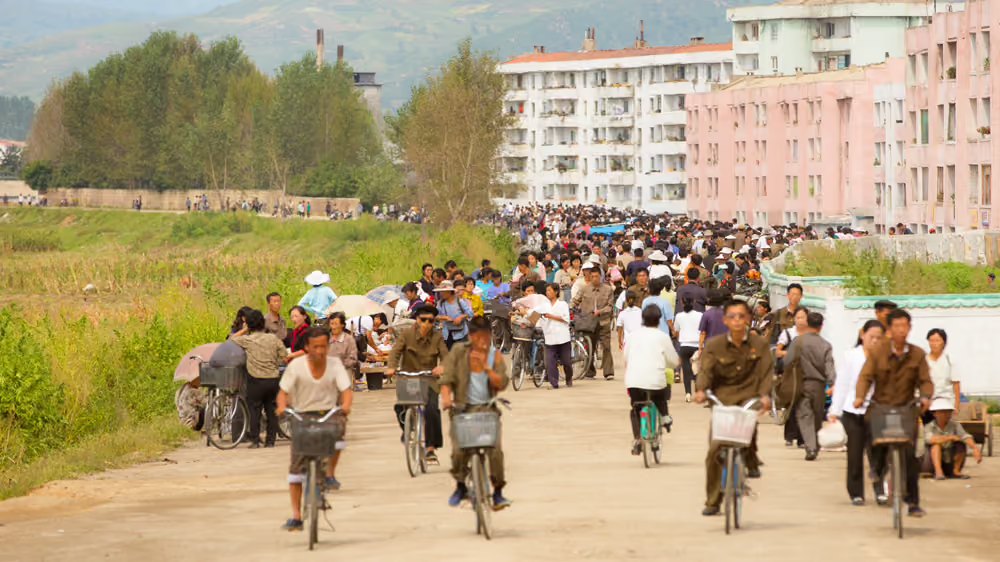
When I think about my past, I often feel a great sense of loss and sorrow for the people I left behind in North Korea. As a PhD student studying North Korean economics here in South Korea, I feel a strong desire to use my research to help improve the lives of North Korean people. In many ways, helping those I left behind also gives meaning to my own journey.
Whenever I watch the news or read academic papers on North Korea, I feel saddened by the way North Korean people are discussed and represented. Over time, I have come to believe that the way we analyze North Korea needs to change.
I believe there is a fundamental limitation in existing research on the North Korean economy, as much of it has traditional socialist planned economy analysis. Earlier studies have suggested that North Korea would either collapse or undergo a system transition as other socialist countries have done. However, after the breakdown of the Public Distribution System (PDS) in the mid-1990s and the emergence of the shadow economy (including through the Jangmadang—illegal markets), these approaches began to reveal their limitations.
As a result, the North Korean economy came to be understood not as a simple planned economy, but as a mixed economy in which state control and market activities coexist. However, these studies do not sufficiently explain why the North Korean regime allows marketization to persist at a certain level instead of completely suppressing it.
In order to explain the interaction between the government and ordinary North Korean citizens, who are the primary actors in Jangmadang activities, I divide the North Korean system into three groups: the regime, the elites, and ordinary citizens.
In particular, elites are important economic actors because they function as intermediaries between the regime and the people. My argument is that this phenomenon can be better understood by analyzing how these three groups strategically interact with one another.
These three groups pursue their interests in different ways, and their goals also differ significantly. The leadership wants to continue dynastic rule and ensure stable succession, the elite seek to secure their positions and avoid political risks such as purges, and ordinary citizens primarily seek survival and improved living conditions.
The interests of these three groups sometimes conflict with one another and sometimes align. In my opinion, these three groups in North Korea are currently remaining in a state of equilibrium.
This equilibrium means that these three groups can achieve their maximum interests under the current conditions in North Korea. Precisely because of this equilibrium, North Korea has been able to maintain both regime stability and limited marketization simultaneously.
That is why I believe we must identify what kind of shocks could cause this equilibrium to collapse. If such a change were to occur, it could become a new turning point for North Korea.
A new turning point for North Korea could lead the country toward a new political and economic order. The important thing is that we must identify what kinds of shocks could trigger such a transformation.
I hope for a North Korea that has changed—a place where its people can live freely. For me, North Korea is not just a state; it is my hometown, where I was born and raised, and where my family still lives. This is precisely why I am committed to a different approach to the North Korean issue—because my only goal is to see genuine change in North Korea, and I truly want to help bring about that change.
I want my article to inspire you to see something different the next time you watch the news or media coverage about North Korea. The next time you come across a piece of media about North Korea, I hope you take a moment to think about the real North Korean people. And perhaps you may also reflect on this article and consider what kinds of shocks could transform the current equilibrium of North Korea.
I hope you will join me on this journey.
–
HyeGyeong is a participant of the LiNK English Language Program (LELP), which serves to not only help North Korean defectors build confidence and skills in English, but develop their capacity as advocates for this issue. To that end, we partnered with select LELP “columnists” to write and polish personal essays through multiple rounds of external feedback and revision. Our goal is to have more North Koreans share their stories directly and lead efforts to change the narrative.
We believe the North Korean people can achieve their liberty in our lifetime.
Opportunities like LELP invest in the people building that future now. Help more North Koreans find their voice, reach their goals, and lead change on this issue.