The Bridge: The Role of North Korean Defectors in a Unified Korea in 2045
By: Eunsook Jang
Eunsook Jang holds a bachelor’s degree in Political Science from Korea University and a master’s degree in International Development from Brandeis University. A Fulbright Scholar and LiNK US Scholarship grantee, she is currently a research intern at the Hudson Institute, where her work focuses on post-conflict recovery, economic development, and human development. Her recent publications include “Slipping through the Cracks in South Korea: The Uncertain Futures for the Children of North Korean Defectors” with the Migration Policy Institute, and “Why Strengthening RFA Is a Strategic Imperative for US Policy on North Korea” in The Diplomat.
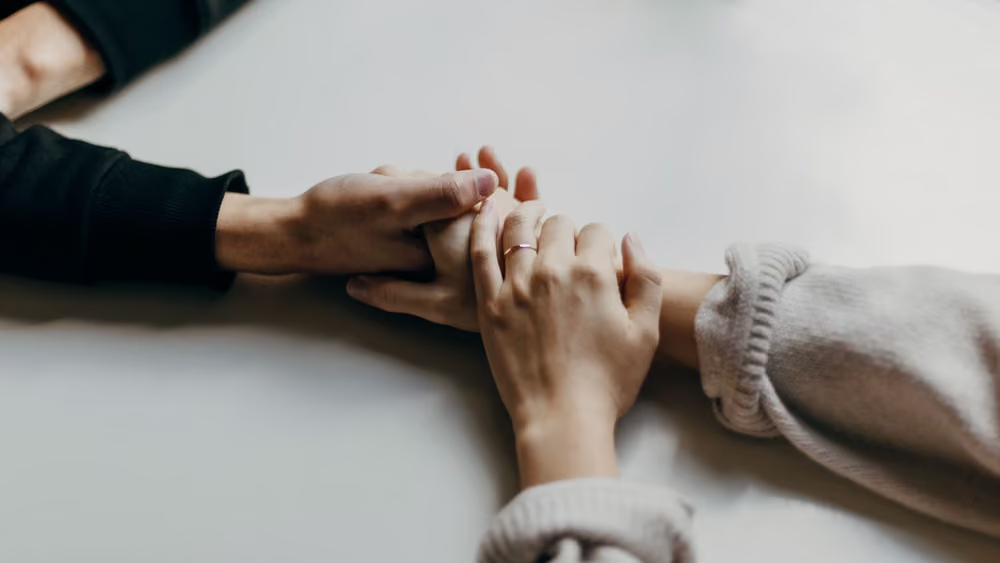
The door opens, and an elderly woman with white hair steps out. It is Emma's mother, Sun. Emma's voice fails her. She collapses into tears. Sun startles at the sound, turns toward Emma, and, in an instant, knows. It is her daughter.
"Euna!" her mother cries. The name no one had spoken aloud for thirty years. "Mom!" Emma answers, and they fall into each other’s arms.
Words fail them. They weep, touching each other's faces and hands as if to make sure the other is real. Emma feels with her palms the smaller body her mother now has, the sharp ridges of her shoulder blades, and cries harder.
"Look how you've grown," her mother manages through tears, cupping Emma's face in both hands. "You've become... a woman."
Emma pulls her closer. "Mom, I'm sorry. I left you alone." Her mother draws her in tighter, and murmurs into her hair: "You are here. You are alive. That is enough. I have missed you."
Sun had prayed to God every day for her daughter's new life, even without fully knowing religion itself.
For the first time since leaving, Emma cries in her mother's arms like a child.
And so for the next several hours, mother and daughter spend their time filling in thirty years of unshared life: how Emma met her husband Sam, how she spent each birthday without family, what it was like to settle into South Korean society.
After a while, Sun asks a kind of question Emma had not expected; a question filled with curiosity, hope, and all the images of South Korea she had imagined from afar.
“Is South Korea really like a K-drama?” Sun asks, her eyes sparkling.
"Yes, it often feels like it" Emma replies with quiet confidence. "I was able to study freely, for the life I wanted."
Sun shakes her head slowly, in something between disbelief and wonder. "To think, if you had stayed in North Korea, none of it would have been imaginable. Graduate school. A life like that. I suppose it really is a drama kind of place."
And yet not everything had felt like a drama. Settlement in South Korea had meant starting from zero: a political system unlike anything she knew, a language full of foreign words that made her feel dizzy just listening to it. She survived by studying fiercely and endured countless hours alone. It was the kind of loneliness that stayed at the back of the throat, the kind you feel when you fall ill and have no one to call, or when you achieve something and have no one to tell.
Emma takes her mother's hand. "Mom, everything will feel enormous and new at first. There will be moments when not knowing even small things makes you feel small too. But I will be there. So don't worry. We'll start this new life together."
As the words leave her mouth, she feels quietly grateful that she had gone through all of it first, knowing the path her mother is about to walk. And she finds herself already picturing it: the two of them sitting across from each other at her favorite pork belly restaurant Dwehyaji (돼야지), near Korea University, sharing a bottle of soju, talking until the night runs out. She smiles to herself at the thought.
The faces of the mentors and friends who had taught her culture and society drift through her mind, one by one, and she carries her gratitude for them again, as the sun goes down over Hyesan.
Emma falls asleep in the very spot where she slept as a child. It still feels like a dream. She closes her eyes, hoping she will not wake if it is.
Author’s note: I dedicate this piece to my father in South Korea, who has never once wavered in encouraging my studies, as if realizing through me the freedom to pursue the dreams that were taken from him. And to my mother, who remains in North Korea: This piece is my proof that your daughter has not turned away from your suffering, but is working, in her own small way, to fight against it. I hope to see you, even if only in my dreams tonight. I love and miss you beyond words.
–
Eunsook is a participant of the LiNK English Language Program (LELP), which serves to not only help North Korean defectors build confidence and skills in English, but develop their capacity as advocates for this issue. To that end, we partnered with select LELP “columnists” to write and polish personal essays through multiple rounds of external feedback and revision. Our goal is to have more North Koreans share their stories directly and lead efforts to change the narrative.
We believe the North Korean people can achieve their liberty in our lifetime.
Opportunities like LELP invest in the people building that future now. Help more North Koreans find their voice, reach their goals, and lead change on this issue.
Give Today
The 2019 LiNK Advocacy Fellows: North Korean Defectors Raising Their Voices

Meet the new class of LiNK Advocacy Fellows! They are already adjusting to life in the U.S. and learning how to become stronger storytellers and better advocates. All four of the AFers have incredible stories they want to share with the world. Here’s a little bit about each of them and what they hope to accomplish during the fellowship! Stay tuned for updates throughout their time here!

Joy
Joy was born in 1991 in Musan, North Korea and escaped when she was 18 years old. When she reached China, the broker who had helped her escape demanded that Joy repay her immediately for her assistance. When Joy couldn’t afford to pay, the broker took her from village to village, trying to sell her as a bride.After three humiliating days, an older Chinese farmer paid $3,000 for her. She tried to find a way to escape but soon became pregnant with the man’s child and gave birth to a daughter.
In 2013, Joy was introduced to LiNK’s network in China and was finally able to reach safety. She is now a university student studying social work in South Korea and wants to dedicate her life to helping families. “I want to be able to share my story in English without a translator’s help. I want to communicate freely and express my thoughts and ideas with others. When I return to South Korea in late November, I want to be able to look back at my time in the U.S. and feel empowered and proud of my work.”
Read more about Joy’s story here.

Ilhyeok
Ilhyeok is from Saetbyeol, North Korea and was born in 1995 at the start of the famine. Growing up, Ilhyeok often missed school to help his family make ends meet by fishing and farming. In order to feed the family, Ilhyeok’s father became a broker who helped defectors living in South Korea send money to their relatives inside North Korea. But when Ilhyeok was only 12, his father was caught and imprisoned for illegally owning a Chinese cell phone. Even after he was released, the authorities kept the family under close surveillance.
Well aware of the risks they would face if they tried to escape, but dreaming of a brighter future, one night llhyeok’s father suggested that the entire family leave their homeland in search of a better life. They fled that very night, and after a long and difficult journey made it to South Korea in 2011.
Ilhyeok is now a senior Political Science and Diplomacy major at Hankuk University of Foreign Studies in Seoul and wants to work for the United Nations one day.“I want to improve my English skills because it is the international language. I want to be able to communicate with everyone so that I can raise awareness about what’s happening in North Korea. And I also want to meet new people from different backgrounds.

Dasom
Dasom was born in 1993 in Gangwon Province, North Korea. When she was seven years old, her family relocated to Hamgyung Province. Before Dasom was even born, her grandfather had been accused of being a spy and was taken away that same day, never to be seen again. Because of North Korea’s system of collective punishment, her grandfather’s alleged crimes severely restricted the jobs she could get after graduating high school. Dasom had no other choice than to join a workers’ group doing manual labor for the government.
After being sexually assaulted at work, Dasom vowed to leave North Korea. She escaped with the help of a North Korean broker but was almost sold to a Chinese broker upon reaching China. Fortunately, a group of North Korean defectors she met connected her with LiNK and she was rescued soon after. She resettled in South Korea in 2014 and dreams of becoming a florist.“I want to be able to look back after the AF program ends and reminisce on all the good memories. I also want a lot of people to remember my story and who I am as a person.”

Jeongyol
Jeongyol was born in 1998 and grew up in Pyongsong, close to North Korea’s capital city Pyongyang. Jeongyol’s father began teaching him math at a young age and by elementary school, he had mastered the middle school math curriculum. In high school, his extraordinary abilities earned him a spot on North Korea’s team for the International Mathematical Olympiad (IMO). In his first IMO in Colombia, Jeongyol won the silver medal. He went on to win the silver medal at the next three IMO competitions.
His success brought the attention of the North Korean government and they offered him a job. He asked for a deferral until after he was finished with his IMO competitions, but realized he’d eventually be forced to work for the regime. At 18, Jeongyol knew that the international competition in Hong Kong would be his last opportunity to defect while abroad. On the last day, while everyone was packing up to return home, he snuck out of the hotel and sought asylum at the South Korean consulate where his dramatic defection made international news.
Jeongyol resettled in South Korea in 2016 and is now a freshman at Seoul National University.“I want to meet people from diverse backgrounds and learn from them. I also want to share my story with as many people as possible.”