
We Call BTS “Bangdan” | Cultural Shifts in North Korea
By: Hannah Oh
Hannah is a North Korea-born intern at Liberty in North Korea’s Seoul office. This article has been reconstructed from her perspective based on DailyNK reports from March 2026.
⏱️ 30-second summary
- K-Pop Power: Young people in North Korea refer to BTS as “BT” to avoid attracting the attention of authorities. They empathize with song lyrics that touch their hearts, in sharp contrast to the ideology prescribed by the state. Even amidst strict crackdowns on South Korean media, people are consuming and sharing K-Pop with their peers.
- Resetting Relationships: It’s now common to see couples in North Korea spending time together in cafes, signaling a change in people’s daily lives. A new culture is emerging where people build relationships by sitting face-to-face over coffee and conversation.
- Expanding Self-Expression: New beauty standards that favor slim bodies and skincare have become popularized. As outside information spreads in North Korea, it’s gradually changing people’s tastes and self-expression.
BTS is a name recognized by people all over the world. This global K-Pop group’s music is even reaching audiences in the most closed country to exist today: North Korea.
The North Korean government severely cracks down on the consumption and spread of foreign media, like South Korean music and dramas. Through foreign media, North Koreans are able to learn things about the outside world that contradict and challenge the regime’s propaganda. In response, the regime passed the “anti-reactionary thought law” in December 2020, which made watching foreign media punishable by 15 years in a political prison camp.
To avoid being caught discussing and sharing about BTS, North Koreans are reportedly shortening the name to “BT.” Even though they cannot directly mention their favorite idol group, they are expressing their fandom by using slang that they understand among themselves.
Changes to daily life in North Korea extend beyond music tastes. From couples quietly conversing in cafes to women experimenting with K-Beauty, this article follows the stories of North Koreans who, despite control and restrictions, are shaping culture and cultivating new standards of leisure, beauty, and expression.
Why North Korean Youth Gravitate Towards K-Pop

It is reported that among young people in North Korea, it is common to refer to BTS, or “Bangtan,” as BT, or “Bangdan,” to avoid the scrutiny of North Korean authorities cracking down on illegal foreign media. Fans in North Korea have cited songs such as “I’m Fine,” “Go,” “Danger,” and “Spring Day” as their favorites, and expressed a desire to dress like the BTS members.
These developments might suggest that instead of foreign media being a taboo topic of discussion, it has become a language of taste shared among peers.
In response to the popularity of South Korean music, North Korean authorities imposed a city-wide lecture series that warned “The only love young people should pursue is revolutionary and comradely love.” However, after the lectures ended, it is reported that the sentiment among young people was that “South Korean song lyrics seem to understand my heart,” and “the emotions they actually feel” over “the emotions permitted by the state.”
Cuppaccinos Over Flowers: Dating Culture in North Korea

In North Korea, there is still a strong perception that cafes are places frequented only by the well-off. However, this year on March 8th for International Women’s Day, reports emerged of husbands visiting coffee shops with their wives, holding hands, and spending time drinking lattes or cappuccinos. Rather than traditional gestures like flowers or doing extra housework, there seems to be a cultural shift of celebrating by spending time together.
After visiting a cafe for the first time, residents reportedly commented that “It’s surprisingly nice because you can talk quietly.” Their perception of this space—previously considered unsuitable for leisure amidst busy lives—changed after actually experiencing it for themselves. The growing popularity of cafes as a space where two people can sit face-to-face and share a private conversation may seem like a minor development, but it is not insignificant.
People’s perceptions and behaviors don’t only change when systems or policies are altered; shifts in how individuals interact and go about their daily lives is also a catalyst for change.
The Far-Reaching Influence of K-Beauty

There have also been reports that interest in beauty treatments and taking care of one’s appearance is growing in North Korea, particularly among affluent women. Younger women have taken to dieting, while middle-aged women are spending money on cosmetic procedures like Botox to reduce wrinkles. North Korean beauty standards have historically favored a fuller figure to look healthy, but now there is an emerging preference to look slimmer. According to one source, this is due to the influence of South Korean culture.
Even in South Korea, there is an ongoing debate as to whether striving for a slim body and youthful appearance is a healthy pursuit. Nevertheless, this shift in North Korean beauty habits is notable.
Individuals are seeking change and acting on their own initiative, influenced by external information, rather than following the standards set out by the regime.
However, it must be noted that these developments seem to be more prominent among wealthy women with financial means, as opposed to the entire population.
Pop Culture as a Catalyst for Change in North Korea
The global influence of K-Pop groups like BTS is usually measured by streaming numbers or chart rankings. But the most significant marker of impact might be found in North Korea, where people risk their lives to listen to their songs. Even in the most closed country in the world, there are people who enjoy heartfelt music, shared conversation over a cup of coffee, and self-care.
If you zoom in past the image of North Korea as a bleak, oppressed country, there are millions of people going about their everyday lives. Small cultural shifts and changing attitudes may seem insignificant. But over time, these compounding changes could bring about transformation in North Korea.
Increasing Information Access for North Korean People
As evidenced by these developments, North Koreans are watching foreign media and have a growing awareness of the outside world. At Liberty in North Korea, we believe that access to uncensored outside information is key to increasing forces of change and opening inside the country. Empowered with information access, North Koreans can imagine a different life for themselves and push the boundaries of the regime’s control.
We work with North Korean partners and engineers to develop and distribute tailored technology and content to help more people inside the country safely access uncensored information.
You can help bring truth to where it’s urgently needed.
Give Today
I Watched K-Dramas Inside North Korea. They Gave Me the Courage to Escape | Hannah’s Story
How many times have you checked your phone today? Fifty? A hundred? Every time we look at the screen we are connected to the world around us and an endless stream of information—news, research, entertainment.
Now imagine waking up tomorrow in a place without the internet. A place where people are executed for sharing foreign media, and where families risk their lives just to stay in touch across borders.
For 26 million people in North Korea, this is their reality. And 7 years ago, I was one of them.
I was born in Hoeryong, a city in the northernmost part of North Korea near the Tumen River. Winters were brutal and there were frequent shortages of fuel and electricity.
My father was a high school physics teacher. He was quiet, loyal and diligent. His days started at 7am in the classroom and went late into the night, even on weekends. But despite his dedication, the monthly rations he received were not enough for our family.
So in order to survive, my mother began selling goods at the market. She wanted a better life for us, and that led her to do the unthinkable—escape North Korea. Three times she tried. Three times she was caught. Each time she was imprisoned and sent to a labor camp.
The prison camp was a living hell. My mother saw women waste away from hunger and die from simple illnesses. She was one of the lucky ones; her family brought her food and medicine, an act that made her a witness to the suffering of others.
I was just 13 when I first visited her, carrying a bowl of rice. In North Korea, it falls to families to provide for their imprisoned relatives.
Seeing my mother stand there like a criminal, her head bowed before the guard, I knew this wasn't right. I should have been in school, but instead, I was sneaking food to her, hiding from the stares of strangers.
We were being punished, but I didn't understand why. I felt wronged, and in my anger, I blamed her.
My mother had made a choice to save her family, but North Korean society saw her as a criminal. My father, who had led a quiet life as a teacher, was denied opportunities at work. Our family was labeled as traitors.
In 2013, on her fourth attempt, my mother finally escaped and made it to South Korea. She worked tirelessly to send money back to North Korea to help our family. She also slowly opened a window into another world.
Using a smuggled Chinese cell phone I was able to speak to my mother from time to time. And on our secret calls she shared with me new South Korean expressions and words she was learning. As she settled into a new society, despite numerous differences, she also recognized similarities between North and South Korea and its people, and reminded me that despite decades of division, we are still one people.
I secretly began watching South Korean sitcoms. I’ll never forget one called “High Kick 3.” In one episode, there was a story about a man who fell into debt and was being chased by collectors. But what shocked me was that his family wasn’t punished for it. In North Korea, if one person “sins” the entire family is condemned. But this showed me that in South Korea, life could be different. That even within a family, you were free to make your own choices.
This realization changed me and offered a glimpse of the vast world beyond North Korea. Information, even in the form of a sitcom, was hope. And it was worth risking everything for.
Meanwhile, I continued to face obstacles in my day to day life. I had learned how to code and use software like photoshop, and I dreamed of going to university after graduation. But because my mother had defected, I was rejected. So I used my computer skills to find work as a photographer and photo editor.
Hoping to advance my career, I volunteered for the "shock brigade," a group sent to do manual labor at dangerous construction sites. While others prayed they wouldn't get picked for this kind of work, I went willingly, thinking it could be my way to a promotion.
I was sent to the Samjiyon district, a place known for its harsh winters. For over a month, I demolished buildings in minus 40-degree weather without protective gear. Dust filled my lungs, and sweat froze my clothes solid. My only relief was being able to sleep in a crumbling basement.
When I returned, expecting the promotion I had been promised, my supervisor simply said, "Let's wait a little longer."
That was the moment I understood my mother. She had risked her life to escape because she was after something more fundamental than a better life. She wanted to live like a human being.
In 2019, I made the same choice and escaped. With the help of Liberty in North Korea, I made it safely to South Korea and reunited with my mom.
Freedom wasn’t as easy as I thought it would be. In North Korea, my tech and computer skills had helped me survive. I had always thought that “no matter where I go, as long as I have a computer, I’ll be fine.” But in South Korea, I struggled with something as simple as a new keyboard layout. In school, subjects like social studies felt foreign because I had grown up in a completely different education system with distorted versions of history and philosophy. My dream of going to college suddenly felt impossible.
Eventually I found my place in science. The formulas and equations in math, chemistry, and physics were the constant, unchanging truths I could always count on.
I decided to major in electrical engineering. It was rare for North Korean defectors to pursue this field. But I was determined to stay ahead and not fall behind in our rapidly changing world. Now my goal is to become an engineer who can help bridge North and South Korea’s science and technology industries when the two countries are one again.
More than ever, I see that information isn’t just about knowledge and convenience—it’s a lifeline. Without access to information, you can’t see a way forward, let alone build a future.
And right now, the people I left behind are more cut off than ever before. During the pandemic, North Korea closed its borders to an unprecedented extent. Soldiers along the border had shoot-to-kill orders for anyone trying to escape. Around 90% of the markets were forced to shut down, leaving families with barely enough to eat. The UN reported that nearly half the population—12 million people—faced food insecurity, while the World Health Organization rated North Korea’s access to medical care as the lowest in the world.
A few years ago, when my father became very sick, I was able to send him money for medicine and hospital care. But most North Koreans don’t have that chance. Without someone on the outside, they are not only cut off from resources and information, but from hope itself. For many, their future depends on a lifeline from the outside world.
Supporting North Korean people and protecting human rights cannot be put off.
We have an opportunity to be a lifeline for people inside North Korea today. To remind them that they have not been forgotten. With your support, we can rescue and support more North Korean refugees, and get more outside information and technology to people inside the country. And that information can empower North Koreans to not only see a way forward, but to ultimately determine their own future.
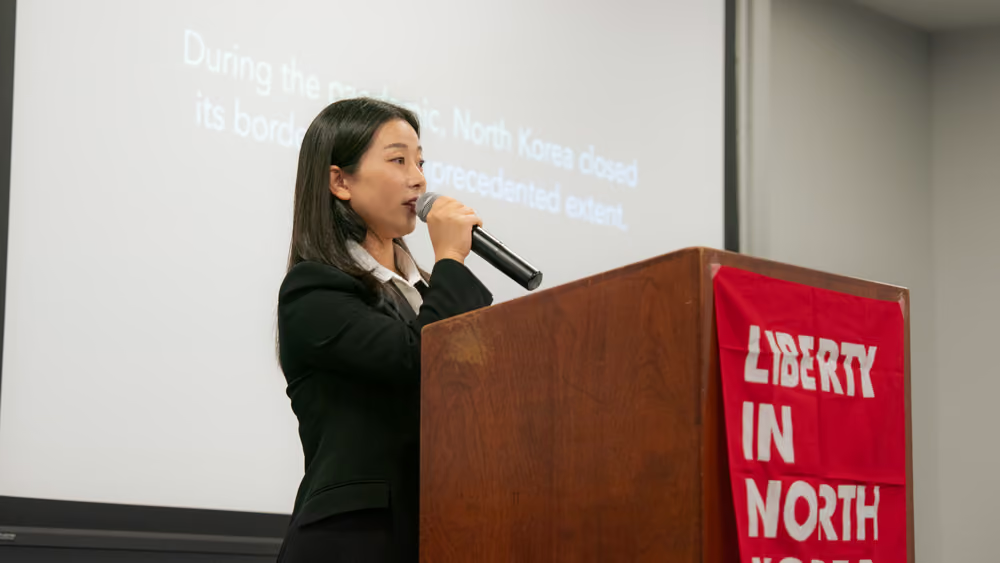
Despite the risks, North Koreans are quietly accessing foreign media and learning about life in the outside world. Increasing their access to uncensored information is one of the most effective ways to increase change inside the country.
Liberty in North Korea partners with North Korean defectors and engineers, like Hannah, to develop technology, content, and tools tailor-made for the North Korea context. Our goal is to empower North Koreans with information about the outside world, increasing their aspirations for social and economic progress, and building pressure for change and opening.










