
We Call BTS “Bangdan” | Cultural Shifts in North Korea
By: Hannah Oh
Hannah is a North Korea-born intern at Liberty in North Korea’s Seoul office. This article has been reconstructed from her perspective based on DailyNK reports from March 2026.
⏱️ 30-second summary
- K-Pop Power: Young people in North Korea refer to BTS as “BT” to avoid attracting the attention of authorities. They empathize with song lyrics that touch their hearts, in sharp contrast to the ideology prescribed by the state. Even amidst strict crackdowns on South Korean media, people are consuming and sharing K-Pop with their peers.
- Resetting Relationships: It’s now common to see couples in North Korea spending time together in cafes, signaling a change in people’s daily lives. A new culture is emerging where people build relationships by sitting face-to-face over coffee and conversation.
- Expanding Self-Expression: New beauty standards that favor slim bodies and skincare have become popularized. As outside information spreads in North Korea, it’s gradually changing people’s tastes and self-expression.
BTS is a name recognized by people all over the world. This global K-Pop group’s music is even reaching audiences in the most closed country to exist today: North Korea.
The North Korean government severely cracks down on the consumption and spread of foreign media, like South Korean music and dramas. Through foreign media, North Koreans are able to learn things about the outside world that contradict and challenge the regime’s propaganda. In response, the regime passed the “anti-reactionary thought law” in December 2020, which made watching foreign media punishable by 15 years in a political prison camp.
To avoid being caught discussing and sharing about BTS, North Koreans are reportedly shortening the name to “BT.” Even though they cannot directly mention their favorite idol group, they are expressing their fandom by using slang that they understand among themselves.
Changes to daily life in North Korea extend beyond music tastes. From couples quietly conversing in cafes to women experimenting with K-Beauty, this article follows the stories of North Koreans who, despite control and restrictions, are shaping culture and cultivating new standards of leisure, beauty, and expression.
Why North Korean Youth Gravitate Towards K-Pop

It is reported that among young people in North Korea, it is common to refer to BTS, or “Bangtan,” as BT, or “Bangdan,” to avoid the scrutiny of North Korean authorities cracking down on illegal foreign media. Fans in North Korea have cited songs such as “I’m Fine,” “Go,” “Danger,” and “Spring Day” as their favorites, and expressed a desire to dress like the BTS members.
These developments might suggest that instead of foreign media being a taboo topic of discussion, it has become a language of taste shared among peers.
In response to the popularity of South Korean music, North Korean authorities imposed a city-wide lecture series that warned “The only love young people should pursue is revolutionary and comradely love.” However, after the lectures ended, it is reported that the sentiment among young people was that “South Korean song lyrics seem to understand my heart,” and “the emotions they actually feel” over “the emotions permitted by the state.”
Cuppaccinos Over Flowers: Dating Culture in North Korea

In North Korea, there is still a strong perception that cafes are places frequented only by the well-off. However, this year on March 8th for International Women’s Day, reports emerged of husbands visiting coffee shops with their wives, holding hands, and spending time drinking lattes or cappuccinos. Rather than traditional gestures like flowers or doing extra housework, there seems to be a cultural shift of celebrating by spending time together.
After visiting a cafe for the first time, residents reportedly commented that “It’s surprisingly nice because you can talk quietly.” Their perception of this space—previously considered unsuitable for leisure amidst busy lives—changed after actually experiencing it for themselves. The growing popularity of cafes as a space where two people can sit face-to-face and share a private conversation may seem like a minor development, but it is not insignificant.
People’s perceptions and behaviors don’t only change when systems or policies are altered; shifts in how individuals interact and go about their daily lives is also a catalyst for change.
The Far-Reaching Influence of K-Beauty

There have also been reports that interest in beauty treatments and taking care of one’s appearance is growing in North Korea, particularly among affluent women. Younger women have taken to dieting, while middle-aged women are spending money on cosmetic procedures like Botox to reduce wrinkles. North Korean beauty standards have historically favored a fuller figure to look healthy, but now there is an emerging preference to look slimmer. According to one source, this is due to the influence of South Korean culture.
Even in South Korea, there is an ongoing debate as to whether striving for a slim body and youthful appearance is a healthy pursuit. Nevertheless, this shift in North Korean beauty habits is notable.
Individuals are seeking change and acting on their own initiative, influenced by external information, rather than following the standards set out by the regime.
However, it must be noted that these developments seem to be more prominent among wealthy women with financial means, as opposed to the entire population.
Pop Culture as a Catalyst for Change in North Korea
The global influence of K-Pop groups like BTS is usually measured by streaming numbers or chart rankings. But the most significant marker of impact might be found in North Korea, where people risk their lives to listen to their songs. Even in the most closed country in the world, there are people who enjoy heartfelt music, shared conversation over a cup of coffee, and self-care.
If you zoom in past the image of North Korea as a bleak, oppressed country, there are millions of people going about their everyday lives. Small cultural shifts and changing attitudes may seem insignificant. But over time, these compounding changes could bring about transformation in North Korea.
Increasing Information Access for North Korean People
As evidenced by these developments, North Koreans are watching foreign media and have a growing awareness of the outside world. At Liberty in North Korea, we believe that access to uncensored outside information is key to increasing forces of change and opening inside the country. Empowered with information access, North Koreans can imagine a different life for themselves and push the boundaries of the regime’s control.
We work with North Korean partners and engineers to develop and distribute tailored technology and content to help more people inside the country safely access uncensored information.
You can help bring truth to where it’s urgently needed.
Give Today
I Left North Korea As a Child. My Life’s Work is to Return Home to a Free Country | Rose’s Story
As a child in North Korea, I loved quiet, warm mornings. At dawn, I’d wake to the sound of breakfast being made in the kitchen. When my feet grew cold, I’d burrow deeper into my grandfather's blanket. A day that began with the smell of a home-cooked meal was nothing special then—just an ordinary morning.
Growing up, I lived with my grandparents. We worked the fields together, swam in the Yalu River side by side, and grew tomatoes, eggplants, and cucumbers in a small garden. In the summers, my cousins and I played in the mountains and gathered wild strawberries. Every fall, I always looked forward to the corn harvest.
This was the world I knew, and I was quite happy with it.
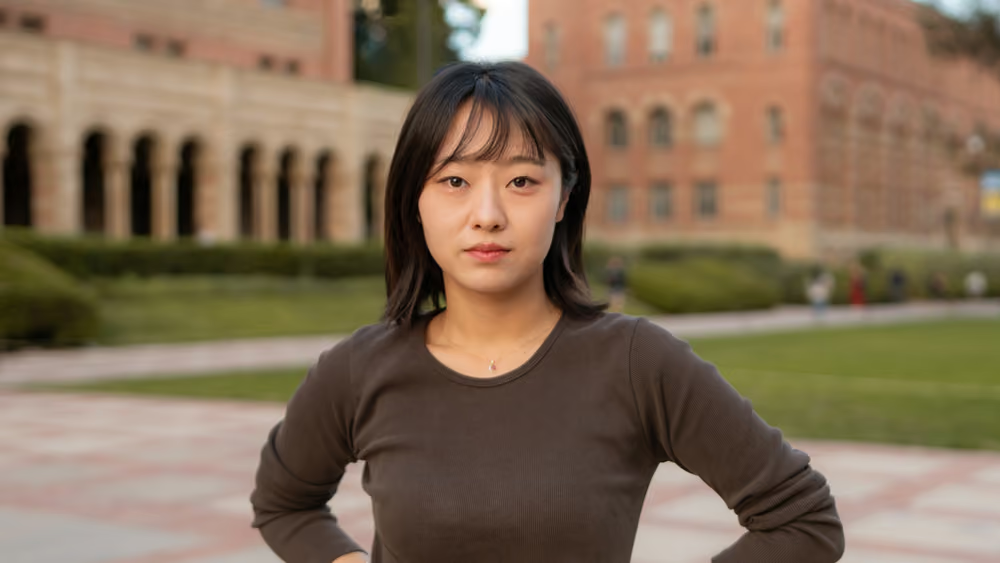
My mother's work as a broker—helping families separated by the border reunite or at least connect via phone—and her other job selling smuggled CDs containing Korean dramas eventually led to her arrest. She was released quickly but was placed under close surveillance. With no other way to support our family, she made the difficult decision to defect. It was a choice made easier, she later told me, by the countless South Korean dramas she had watched over the years that offered a glimpse into a life outside North Korea.
One winter vacation, my mother said, "Let’s go on a trip." I could barely contain my excitement. I had rarely ventured far from my hometown and thought I was finally traveling somewhere new. My grandmother gave me a warm boiled egg and told me to be safe. I didn’t know that would be the last time I would ever see her.
The journey never stopped. We left in winter and ended up in Southeast Asia, where summer never ends. Only then did I realize this trip was an escape. And it was only one-way.
When we finally arrived in South Korea, I couldn’t accept my new reality. I was only a child, but in my heart, I knew I’d never see my grandparents again. It felt like a cruel trick.
But life carried on, and I found myself adapting to South Korean society pretty quickly. I changed my accent and learned things by asking friends. Even at a young age, I instinctively felt the need to fit in. I was proud of myself for not looking or sounding like a North Korean.
Then one day in our elementary school classroom, the topic of North Korea came up. At that moment, I felt everyone’s eyes on me.
Although no words were spoken, the silence between me and my classmates felt like a wall.
As much as I tried to push it away, that feeling continued to follow me. In middle school, while watching a soccer game with friends and cheering for South Korea, someone said, “Shouldn’t you be rooting for North Korea?” I felt the color drain from my face. Once again, I felt the gap between me and them. And I wondered if I could ever close the distance.
Years later, in university, a professor mistakenly thought my South Korean friend was North Korean. She strongly denied it and took great offense, demanding a formal apology from the professor. Seeing her reaction, I wondered what it said about me. This incident left a deep scar on my heart.
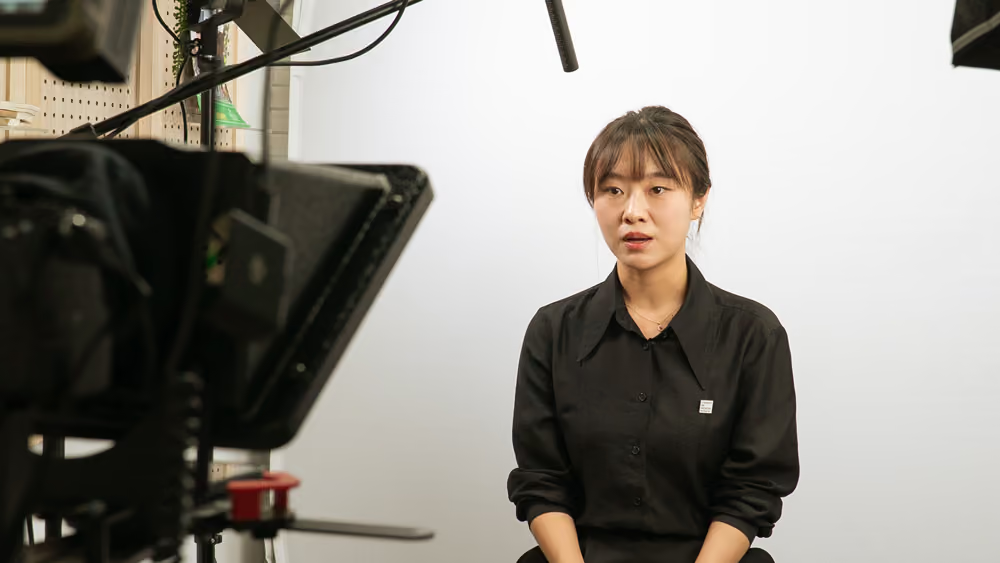
As time went on, I realized that I wasn’t as well-adapted as I thought. I had been living my life avoiding who I was. Whenever the topic of North Korea came up in conversation, I cringed and tried to change the subject. When my family in North Korea would secretly call us, I would hang up the phone after a brief greeting, afraid I’d burst into tears. I couldn’t face how much I missed them, because I didn’t want to accept that I may never see them again.
Amidst these complex emotions, I began my work on North Korean human rights. I wanted to change how North Koreans were portrayed as “pitiful,” or “dangerous.”
But doing this work scared me at first. If I shared my story, would people look at me again with those silent, disapproving eyes? Then I began to understand something important—those fears came from my own hidden prejudice. If I believed that North Koreans would only be seen in a certain way, didn’t that also mean it was how I saw them?
Confronting the deepest parts of myself allowed me to finally embrace who I was. I stopped hiding, and began to explore the thoughts and feelings I had suppressed for so long.
In 2022, I took part in Liberty in North Korea’s Co-Creators program. It’s a unique opportunity for North and South Korean students to work together on advocacy projects. Our team’s project was called “North Korea Travel.” We highlighted different regions of the country and shared facts about life there, leading naturally into conversations about human rights.
As I worked on this project, it occurred to me how much I actually didn’t know about my own country. Due to the regime’s strict restrictions on movement, I never traveled beyond my hometown until the day I left North Korea for good. When I explained this to participants, they listened attentively and said it was their first time learning about it.
Their sincerity caught me off guard. I realized that prejudice often does not come from malice, but simply from a lack of knowledge and understanding.
After that experience, I knew I wanted to continue creating moments of connection and understanding about North Korea. I figured the perfect way to reach people would be through the medium I know best: architecture.
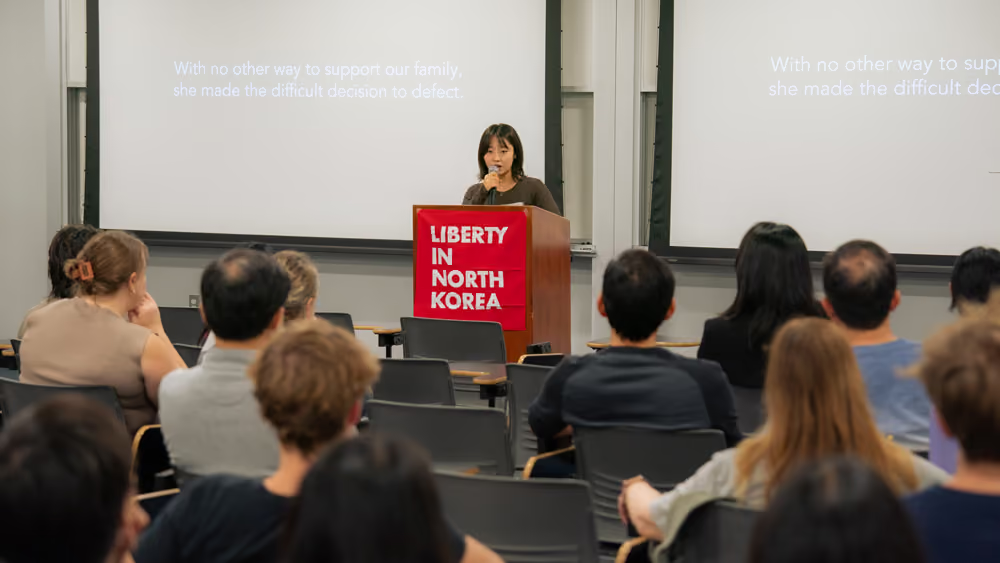
For my graduation project, I designed a North Korean Human Rights Memorial Hall. I chose Imjingak, near the DMZ, as the symbolic location. The space I conceptualized commemorates the sorrow of separation, and allows visitors to experience the "surveillance," "chaos," and "oppression" North Koreans face in their daily lives.
The Pantheon in Rome directs our gaze toward the sky. I turned that idea upside down. In my design, the ceiling collapses into the ground, trapping people beneath, like the crushing weight of the regime’s oppression.
On the opposite wall, the names of loved ones are carved into stone, representing those we miss dearly. Before politics, before ideology, these are mothers and fathers, grandparents and children. This is a space where people can freely miss and yearn for the people they left behind. And it is a reminder that North Korea is home to our families, friends and neighbors.
Last year, when I visited the Holocaust Memorial in Washington DC, I felt that it was more than just a commemorative site. It was a space that showcased how to confront humanity's darkest history to ensure that such things are never repeated again.
Standing there, I hoped that one day, the human rights abuses faced by North Koreans would also just be a memory for us to reflect on.
I no longer hide my identity. My story began in North Korea, in a beautiful city by the Yalu River. Even now, on quiet mornings, my thoughts drift back to my grandparents’ house. I want the world to see North Korea like I do—through the warmth of ordinary days and the humanity of its people.
I dream of returning home one day, when all North Koreans can live free and full lives. Until then, I will continue to speak through the language of space and the power of stories.
The Universal Declaration of Human Rights begins with this: "all human beings are born free and equal in dignity and rights." These aren’t just words on paper, but a reality that we can create together.
Please join me today to advance freedom and human rights for all North Koreans.
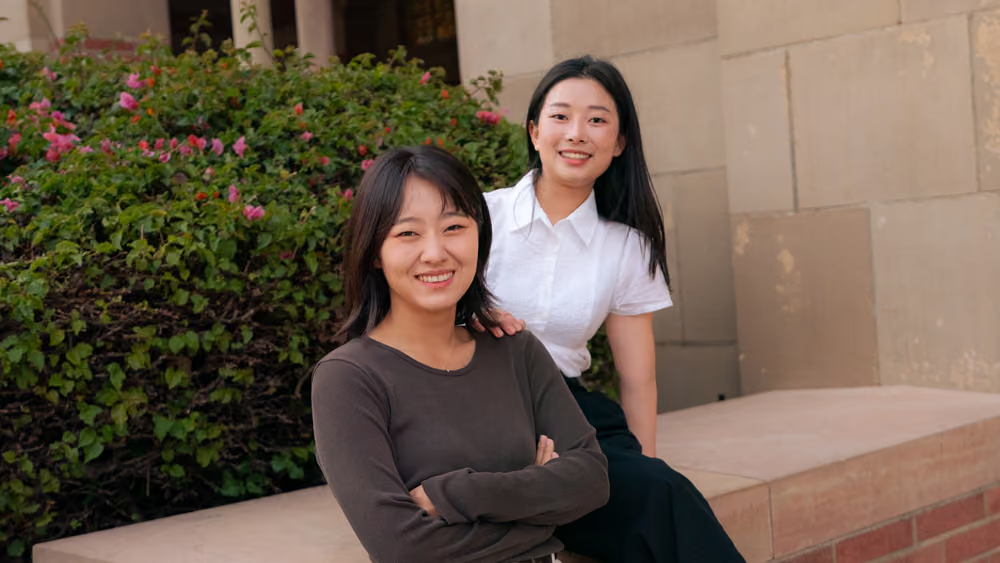
In 2025, Rose traveled across the US, sharing her story and advocating for the North Korean people as a LiNK Advocacy Fellow. Our capacity-building programs are cultivating the next generation of North Korean activists and leaders who are bringing change to their homeland.
Help empower more North Korean refugees with opportunities to grow, like Rose.










