
We Call BTS “Bangdan” | Cultural Shifts in North Korea
By: Hannah Oh
Hannah is a North Korea-born intern at Liberty in North Korea’s Seoul office. This article has been reconstructed from her perspective based on DailyNK reports from March 2026.
⏱️ 30-second summary
- K-Pop Power: Young people in North Korea refer to BTS as “BT” to avoid attracting the attention of authorities. They empathize with song lyrics that touch their hearts, in sharp contrast to the ideology prescribed by the state. Even amidst strict crackdowns on South Korean media, people are consuming and sharing K-Pop with their peers.
- Resetting Relationships: It’s now common to see couples in North Korea spending time together in cafes, signaling a change in people’s daily lives. A new culture is emerging where people build relationships by sitting face-to-face over coffee and conversation.
- Expanding Self-Expression: New beauty standards that favor slim bodies and skincare have become popularized. As outside information spreads in North Korea, it’s gradually changing people’s tastes and self-expression.
BTS is a name recognized by people all over the world. This global K-Pop group’s music is even reaching audiences in the most closed country to exist today: North Korea.
The North Korean government severely cracks down on the consumption and spread of foreign media, like South Korean music and dramas. Through foreign media, North Koreans are able to learn things about the outside world that contradict and challenge the regime’s propaganda. In response, the regime passed the “anti-reactionary thought law” in December 2020, which made watching foreign media punishable by 15 years in a political prison camp.
To avoid being caught discussing and sharing about BTS, North Koreans are reportedly shortening the name to “BT.” Even though they cannot directly mention their favorite idol group, they are expressing their fandom by using slang that they understand among themselves.
Changes to daily life in North Korea extend beyond music tastes. From couples quietly conversing in cafes to women experimenting with K-Beauty, this article follows the stories of North Koreans who, despite control and restrictions, are shaping culture and cultivating new standards of leisure, beauty, and expression.
Why North Korean Youth Gravitate Towards K-Pop

It is reported that among young people in North Korea, it is common to refer to BTS, or “Bangtan,” as BT, or “Bangdan,” to avoid the scrutiny of North Korean authorities cracking down on illegal foreign media. Fans in North Korea have cited songs such as “I’m Fine,” “Go,” “Danger,” and “Spring Day” as their favorites, and expressed a desire to dress like the BTS members.
These developments might suggest that instead of foreign media being a taboo topic of discussion, it has become a language of taste shared among peers.
In response to the popularity of South Korean music, North Korean authorities imposed a city-wide lecture series that warned “The only love young people should pursue is revolutionary and comradely love.” However, after the lectures ended, it is reported that the sentiment among young people was that “South Korean song lyrics seem to understand my heart,” and “the emotions they actually feel” over “the emotions permitted by the state.”
Cuppaccinos Over Flowers: Dating Culture in North Korea

In North Korea, there is still a strong perception that cafes are places frequented only by the well-off. However, this year on March 8th for International Women’s Day, reports emerged of husbands visiting coffee shops with their wives, holding hands, and spending time drinking lattes or cappuccinos. Rather than traditional gestures like flowers or doing extra housework, there seems to be a cultural shift of celebrating by spending time together.
After visiting a cafe for the first time, residents reportedly commented that “It’s surprisingly nice because you can talk quietly.” Their perception of this space—previously considered unsuitable for leisure amidst busy lives—changed after actually experiencing it for themselves. The growing popularity of cafes as a space where two people can sit face-to-face and share a private conversation may seem like a minor development, but it is not insignificant.
People’s perceptions and behaviors don’t only change when systems or policies are altered; shifts in how individuals interact and go about their daily lives is also a catalyst for change.
The Far-Reaching Influence of K-Beauty

There have also been reports that interest in beauty treatments and taking care of one’s appearance is growing in North Korea, particularly among affluent women. Younger women have taken to dieting, while middle-aged women are spending money on cosmetic procedures like Botox to reduce wrinkles. North Korean beauty standards have historically favored a fuller figure to look healthy, but now there is an emerging preference to look slimmer. According to one source, this is due to the influence of South Korean culture.
Even in South Korea, there is an ongoing debate as to whether striving for a slim body and youthful appearance is a healthy pursuit. Nevertheless, this shift in North Korean beauty habits is notable.
Individuals are seeking change and acting on their own initiative, influenced by external information, rather than following the standards set out by the regime.
However, it must be noted that these developments seem to be more prominent among wealthy women with financial means, as opposed to the entire population.
Pop Culture as a Catalyst for Change in North Korea
The global influence of K-Pop groups like BTS is usually measured by streaming numbers or chart rankings. But the most significant marker of impact might be found in North Korea, where people risk their lives to listen to their songs. Even in the most closed country in the world, there are people who enjoy heartfelt music, shared conversation over a cup of coffee, and self-care.
If you zoom in past the image of North Korea as a bleak, oppressed country, there are millions of people going about their everyday lives. Small cultural shifts and changing attitudes may seem insignificant. But over time, these compounding changes could bring about transformation in North Korea.
Increasing Information Access for North Korean People
As evidenced by these developments, North Koreans are watching foreign media and have a growing awareness of the outside world. At Liberty in North Korea, we believe that access to uncensored outside information is key to increasing forces of change and opening inside the country. Empowered with information access, North Koreans can imagine a different life for themselves and push the boundaries of the regime’s control.
We work with North Korean partners and engineers to develop and distribute tailored technology and content to help more people inside the country safely access uncensored information.
You can help bring truth to where it’s urgently needed.
Give Today
The Bridge: The Role of North Korean Defectors in a Unified Korea in 2045
By: Eunsook Jang
Eunsook Jang holds a bachelor’s degree in Political Science from Korea University and a master’s degree in International Development from Brandeis University. A Fulbright Scholar and LiNK US Scholarship grantee, she is currently a research intern at the Hudson Institute, where her work focuses on post-conflict recovery, economic development, and human development. Her recent publications include “Slipping through the Cracks in South Korea: The Uncertain Futures for the Children of North Korean Defectors” with the Migration Policy Institute, and “Why Strengthening RFA Is a Strategic Imperative for US Policy on North Korea” in The Diplomat.
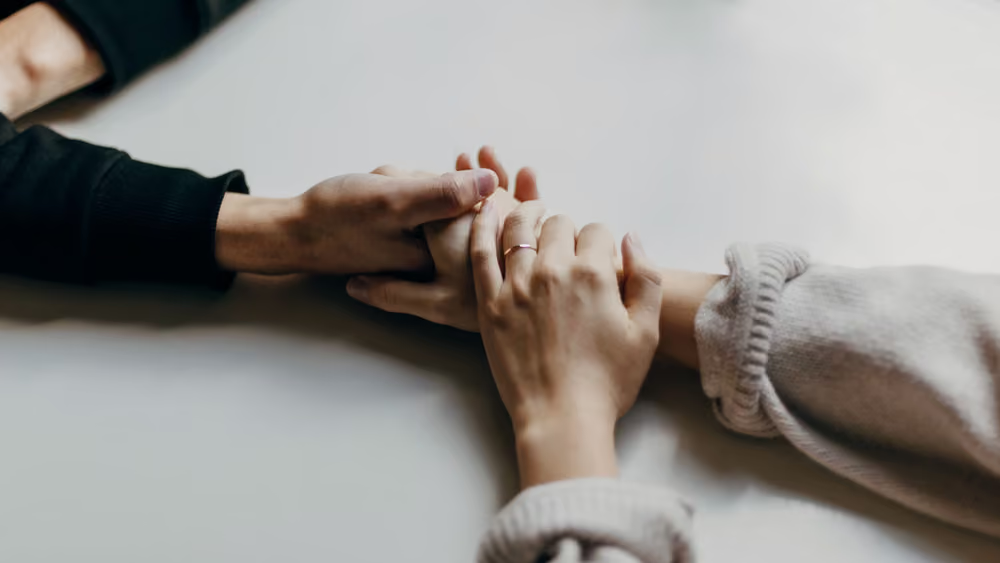
The door opens, and an elderly woman with white hair steps out. It is Emma's mother, Sun. Emma's voice fails her. She collapses into tears. Sun startles at the sound, turns toward Emma, and, in an instant, knows. It is her daughter.
"Euna!" her mother cries. The name no one had spoken aloud for thirty years. "Mom!" Emma answers, and they fall into each other’s arms.
Words fail them. They weep, touching each other's faces and hands as if to make sure the other is real. Emma feels with her palms the smaller body her mother now has, the sharp ridges of her shoulder blades, and cries harder.
"Look how you've grown," her mother manages through tears, cupping Emma's face in both hands. "You've become... a woman."
Emma pulls her closer. "Mom, I'm sorry. I left you alone." Her mother draws her in tighter, and murmurs into her hair: "You are here. You are alive. That is enough. I have missed you."
Sun had prayed to God every day for her daughter's new life, even without fully knowing religion itself.
For the first time since leaving, Emma cries in her mother's arms like a child.
And so for the next several hours, mother and daughter spend their time filling in thirty years of unshared life: how Emma met her husband Sam, how she spent each birthday without family, what it was like to settle into South Korean society.
After a while, Sun asks a kind of question Emma had not expected; a question filled with curiosity, hope, and all the images of South Korea she had imagined from afar.
“Is South Korea really like a K-drama?” Sun asks, her eyes sparkling.
"Yes, it often feels like it" Emma replies with quiet confidence. "I was able to study freely, for the life I wanted."
Sun shakes her head slowly, in something between disbelief and wonder. "To think, if you had stayed in North Korea, none of it would have been imaginable. Graduate school. A life like that. I suppose it really is a drama kind of place."
And yet not everything had felt like a drama. Settlement in South Korea had meant starting from zero: a political system unlike anything she knew, a language full of foreign words that made her feel dizzy just listening to it. She survived by studying fiercely and endured countless hours alone. It was the kind of loneliness that stayed at the back of the throat, the kind you feel when you fall ill and have no one to call, or when you achieve something and have no one to tell.
Emma takes her mother's hand. "Mom, everything will feel enormous and new at first. There will be moments when not knowing even small things makes you feel small too. But I will be there. So don't worry. We'll start this new life together."
As the words leave her mouth, she feels quietly grateful that she had gone through all of it first, knowing the path her mother is about to walk. And she finds herself already picturing it: the two of them sitting across from each other at her favorite pork belly restaurant Dwehyaji (돼야지), near Korea University, sharing a bottle of soju, talking until the night runs out. She smiles to herself at the thought.
The faces of the mentors and friends who had taught her culture and society drift through her mind, one by one, and she carries her gratitude for them again, as the sun goes down over Hyesan.
Emma falls asleep in the very spot where she slept as a child. It still feels like a dream. She closes her eyes, hoping she will not wake if it is.
Author’s note: I dedicate this piece to my father in South Korea, who has never once wavered in encouraging my studies, as if realizing through me the freedom to pursue the dreams that were taken from him. And to my mother, who remains in North Korea: This piece is my proof that your daughter has not turned away from your suffering, but is working, in her own small way, to fight against it. I hope to see you, even if only in my dreams tonight. I love and miss you beyond words.
–
Eunsook is a participant of the LiNK English Language Program (LELP), which serves to not only help North Korean defectors build confidence and skills in English, but develop their capacity as advocates for this issue. To that end, we partnered with select LELP “columnists” to write and polish personal essays through multiple rounds of external feedback and revision. Our goal is to have more North Koreans share their stories directly and lead efforts to change the narrative.
We believe the North Korean people can achieve their liberty in our lifetime.
Opportunities like LELP invest in the people building that future now. Help more North Koreans find their voice, reach their goals, and lead change on this issue.










