Freedom Walk & Run 2026, Seoul
What Does Freedom Mean to You?
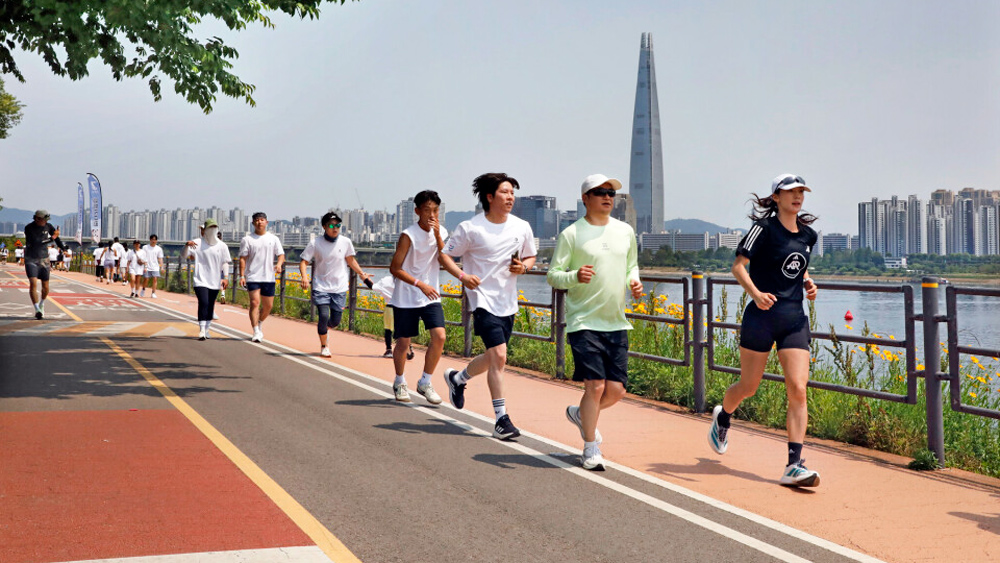
This fall, 200 people will gather along the Han River in Seoul to honor the 26 million people living in North Korea by answering one question: What does freedom mean to you?
Before setting out, every participant in Liberty in North Korea’s Freedom Walk & Run will write their own answers on the race bib they’ll wear for the 6 kilometer race.
The course is divided into three sections, each representing a different freedom: the freedom to leave, the freedom to lead, and the freedom to learn.
Each represents a different part of LiNK’s work and a different way North Korean people are pursuing greater freedom and choice in their own lives.
0-2km: Freedom to Leave
The first two kilometers represent the freedom to leave.
For North Koreans who decide to leave their country, reaching safety can mean a long and dangerous journey through multiple countries.
LiNK helps North Korean refugees navigate a secret route to safety. To date, over 1,400 North Korean refugees have reached freedom through LiNK’s networks. Every person who makes that journey has their own reason for leaving, their own hopes for what comes next, and their own idea of what freedom means to them.
Reaching safety opens the door to the next part of their journey.
2km-4km: Freedom to Lead
The next two kilometers represent the freedom to lead.
Starting over in a new country comes with countless possibilities, but just as many challenges. North Korean people resettling in South Korea or the US are learning a new system, while pursuing education, beginning careers, building relationships, or deciding what they want their future to look like.
LiNK’s programs support resettled North Koreans as they pursue education, language learning, and career development, providing mentorship, scholarships, and so much more.
And then comes the final stretch.
4-6km: Freedom to Learn
The last two kilometers represent the freedom to learn.
For people living inside North Korea, access to information from outside of the country is heavily restricted. Official media is centrally controlled, while foreign films, television, music, news, and other outside information are accessed illegally and often at significant personal risk.
Despite the government’s efforts to control information, curiosity about what freedom looks like proves impossible to suppress.
“No matter how much you try to control it, you can’t get rid of curiosity.”
Information gives someone a new point of reference. It introduces possibilities they had never encountered before. It gives them the chance to imagine a future beyond the North Korean regime.
North Korean people are finding ways to access outside media, through USB drives and microSD cards. LiNK’s Information Access Programs build on these existing channels by working with North Korean defectors and engineers to develop tailor-made technology and content that help people inside the country access more information more safely.
This is a growing part of our work, and one we believe has enormous potential to contribute to long-term change.
Get Involved: Support information access in North Korea
This fall, we’re giving supporters a closer look at this work through an upcoming documentary about information access in North Korea.
Make a gift of $30 or more to LiNK’s Information Access Programs by October 24 and you’ll receive an exclusive preview of the documentary this fall.
Your support helps LiNK enable more North Koreans to access more outside information more safely. This builds people’s resilience against regime disinformation, increases their aspirations for social and economic progress, and builds pressure for change and opening.
Donate today & get the documentary preview
Join us in Seoul
If you’re in Seoul, join us along the Han River on Saturday, October 24, for the Freedom Walk & Run. Participation is limited to 200 people, so reserve your spot today.
RSVP for LiNK’s Freedom Walk & Run
The 2019 LiNK Advocacy Fellows: North Korean Defectors Raising Their Voices

Meet the new class of LiNK Advocacy Fellows! They are already adjusting to life in the U.S. and learning how to become stronger storytellers and better advocates. All four of the AFers have incredible stories they want to share with the world. Here’s a little bit about each of them and what they hope to accomplish during the fellowship! Stay tuned for updates throughout their time here!

Joy
Joy was born in 1991 in Musan, North Korea and escaped when she was 18 years old. When she reached China, the broker who had helped her escape demanded that Joy repay her immediately for her assistance. When Joy couldn’t afford to pay, the broker took her from village to village, trying to sell her as a bride.After three humiliating days, an older Chinese farmer paid $3,000 for her. She tried to find a way to escape but soon became pregnant with the man’s child and gave birth to a daughter.
In 2013, Joy was introduced to LiNK’s network in China and was finally able to reach safety. She is now a university student studying social work in South Korea and wants to dedicate her life to helping families. “I want to be able to share my story in English without a translator’s help. I want to communicate freely and express my thoughts and ideas with others. When I return to South Korea in late November, I want to be able to look back at my time in the U.S. and feel empowered and proud of my work.”
Read more about Joy’s story here.

Ilhyeok
Ilhyeok is from Saetbyeol, North Korea and was born in 1995 at the start of the famine. Growing up, Ilhyeok often missed school to help his family make ends meet by fishing and farming. In order to feed the family, Ilhyeok’s father became a broker who helped defectors living in South Korea send money to their relatives inside North Korea. But when Ilhyeok was only 12, his father was caught and imprisoned for illegally owning a Chinese cell phone. Even after he was released, the authorities kept the family under close surveillance.
Well aware of the risks they would face if they tried to escape, but dreaming of a brighter future, one night llhyeok’s father suggested that the entire family leave their homeland in search of a better life. They fled that very night, and after a long and difficult journey made it to South Korea in 2011.
Ilhyeok is now a senior Political Science and Diplomacy major at Hankuk University of Foreign Studies in Seoul and wants to work for the United Nations one day.“I want to improve my English skills because it is the international language. I want to be able to communicate with everyone so that I can raise awareness about what’s happening in North Korea. And I also want to meet new people from different backgrounds.

Dasom
Dasom was born in 1993 in Gangwon Province, North Korea. When she was seven years old, her family relocated to Hamgyung Province. Before Dasom was even born, her grandfather had been accused of being a spy and was taken away that same day, never to be seen again. Because of North Korea’s system of collective punishment, her grandfather’s alleged crimes severely restricted the jobs she could get after graduating high school. Dasom had no other choice than to join a workers’ group doing manual labor for the government.
After being sexually assaulted at work, Dasom vowed to leave North Korea. She escaped with the help of a North Korean broker but was almost sold to a Chinese broker upon reaching China. Fortunately, a group of North Korean defectors she met connected her with LiNK and she was rescued soon after. She resettled in South Korea in 2014 and dreams of becoming a florist.“I want to be able to look back after the AF program ends and reminisce on all the good memories. I also want a lot of people to remember my story and who I am as a person.”

Jeongyol
Jeongyol was born in 1998 and grew up in Pyongsong, close to North Korea’s capital city Pyongyang. Jeongyol’s father began teaching him math at a young age and by elementary school, he had mastered the middle school math curriculum. In high school, his extraordinary abilities earned him a spot on North Korea’s team for the International Mathematical Olympiad (IMO). In his first IMO in Colombia, Jeongyol won the silver medal. He went on to win the silver medal at the next three IMO competitions.
His success brought the attention of the North Korean government and they offered him a job. He asked for a deferral until after he was finished with his IMO competitions, but realized he’d eventually be forced to work for the regime. At 18, Jeongyol knew that the international competition in Hong Kong would be his last opportunity to defect while abroad. On the last day, while everyone was packing up to return home, he snuck out of the hotel and sought asylum at the South Korean consulate where his dramatic defection made international news.
Jeongyol resettled in South Korea in 2016 and is now a freshman at Seoul National University.“I want to meet people from diverse backgrounds and learn from them. I also want to share my story with as many people as possible.”