
Freedom Walk & Run 2026, Seoul
What Does Freedom Mean to You?
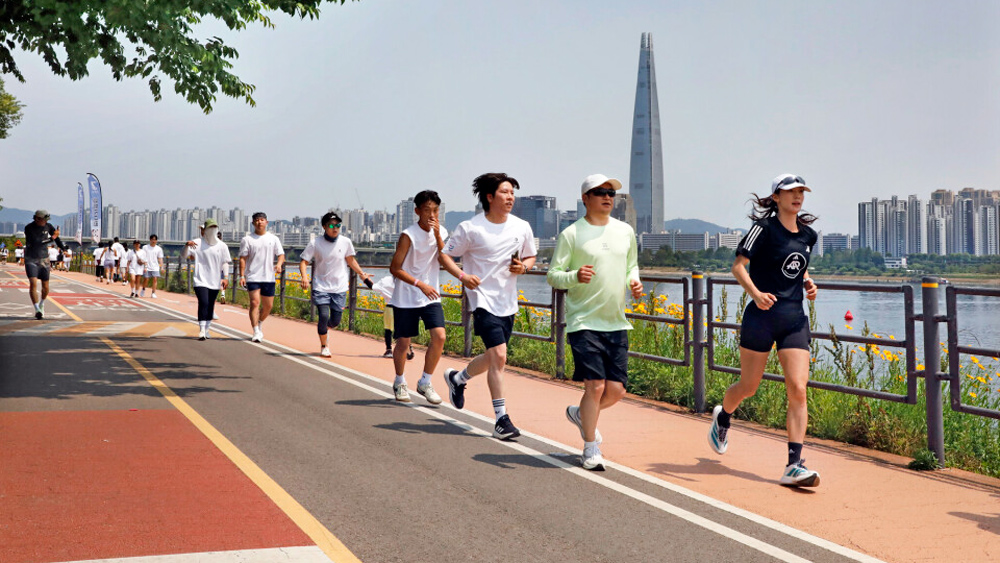
This fall, 200 people will gather along the Han River in Seoul to honor the 26 million people living in North Korea by answering one question: What does freedom mean to you?
Before setting out, every participant in Liberty in North Korea’s Freedom Walk & Run will write their own answers on the race bib they’ll wear for the 6 kilometer race.
The course is divided into three sections, each representing a different freedom: the freedom to leave, the freedom to lead, and the freedom to learn.
Each represents a different part of LiNK’s work and a different way North Korean people are pursuing greater freedom and choice in their own lives.
0-2km: Freedom to Leave
The first two kilometers represent the freedom to leave.
For North Koreans who decide to leave their country, reaching safety can mean a long and dangerous journey through multiple countries.
LiNK helps North Korean refugees navigate a secret route to safety. To date, over 1,400 North Korean refugees have reached freedom through LiNK’s networks. Every person who makes that journey has their own reason for leaving, their own hopes for what comes next, and their own idea of what freedom means to them.
Reaching safety opens the door to the next part of their journey.
2km-4km: Freedom to Lead
The next two kilometers represent the freedom to lead.
Starting over in a new country comes with countless possibilities, but just as many challenges. North Korean people resettling in South Korea or the US are learning a new system, while pursuing education, beginning careers, building relationships, or deciding what they want their future to look like.
LiNK’s programs support resettled North Koreans as they pursue education, language learning, and career development, providing mentorship, scholarships, and so much more.
And then comes the final stretch.
4-6km: Freedom to Learn
The last two kilometers represent the freedom to learn.
For people living inside North Korea, access to information from outside of the country is heavily restricted. Official media is centrally controlled, while foreign films, television, music, news, and other outside information are accessed illegally and often at significant personal risk.
Despite the government’s efforts to control information, curiosity about what freedom looks like proves impossible to suppress.
“No matter how much you try to control it, you can’t get rid of curiosity.”
Information gives someone a new point of reference. It introduces possibilities they had never encountered before. It gives them the chance to imagine a future beyond the North Korean regime.
North Korean people are finding ways to access outside media, through USB drives and microSD cards. LiNK’s Information Access Programs build on these existing channels by working with North Korean defectors and engineers to develop tailor-made technology and content that help people inside the country access more information more safely.
This is a growing part of our work, and one we believe has enormous potential to contribute to long-term change.
Get Involved: Support information access in North Korea
This fall, we’re giving supporters a closer look at this work through an upcoming documentary about information access in North Korea.
Make a gift of $30 or more to LiNK’s Information Access Programs by October 24 and you’ll receive an exclusive preview of the documentary this fall.
Your support helps LiNK enable more North Koreans to access more outside information more safely. This builds people’s resilience against regime disinformation, increases their aspirations for social and economic progress, and builds pressure for change and opening.
Donate today & get the documentary preview
Join us in Seoul
If you’re in Seoul, join us along the Han River on Saturday, October 24, for the Freedom Walk & Run. Participation is limited to 200 people, so reserve your spot today.
RSVP for LiNK’s Freedom Walk & Run
Yoon Ha's Story: Part 3 - Making it to South Korea

This is the third part of a three-part story. Read part one about the hardships Yoon Ha experienced growing up in North Korea, and part two about being trafficked in China.
After connecting with LiNK’s network, I had to hike up more mountains to get out of China. It was very difficult being eight-months pregnant. My legs hurt and began to swell up a lot. It was really dark and I fell a few times. It was so hard - I was completely exhausted.
There were other North Koreans escaping China with me and they were pulling me and helping me up. Whenever I wanted to give up, they encouraged me.
“We must go. We must go to South Korea to live. To live…”
I felt like it was my responsibility to keep going and to survive for myself and my daughter. The journey getting out of China was so tough. I was worried that my unborn baby might have died because I didn’t feel the baby moving in my stomach for a while.
After many months in government processing and after going through the Hanawon resettlement education center, I was finally able to live freely in South Korea. I was overjoyed.
Thankfully, my baby survived and I had a beautiful baby daughter right after I came to South Korea. More than a year later now, I am thankful that she is growing well and is in good health.

In North Korea, the police oppressed me, keeping me from doing what I needed to do to survive. And in China, the police were trying to find North Korean refugees who were living in hiding. They wanted to send us back to North Korea, even though they knew we would be brutally punished by the regime. Whenever the police came around, I locked all the doors and hid in fear until they left town. So at first, I was scared of the police in South Korea.
I got to know my assigned police officer and realized he is just a person like me and we are not that different. (Every resettled North Korean refugee in South Korea is assigned a police officer for their first five years. They check in on them on a regular basis, and provide basic legal advice and special protection if necessary.)
We talked openly and he shared about the challenges he had when he was younger. He calls me once a week to see how my daughter and I are doing. He has brought us fruit and diapers for my daughter. He is so sweet. He also helped me with paperwork, paying bills, and getting my phone fixed when it broke. I really appreciate him and now he feels like a friend to me.
Thanks to people like him, I can sleep well.

I have been surrounded by many good people from my church community, the Hana Center (the local South Korean government resettlement assistance center) and my designated police officer.
It felt so good to talk freely with many people in my first language--Korean. I had lived in China for many years and when I first went there, I knew no Chinese. I struggled so much with communicating and I couldn’t talk to people freely either because of the fear of getting caught.
Now I can talk to anyone without worrying about getting caught.
I am so glad I came to South Korea. My life here is much better than my life in North Korea or China. I feel very safe and free in South Korea.

I am still learning the meaning of freedom as I experience it in this new society. I can do what I want and go where I want to go. I can go somewhere just to have fun and no one stops me.
That is freedom to me, and I am living it right now.










