
North Korean Defector Economist: How We Analyze North Korea Needs to Change
By: HyeGyeong Joo
HyeGyeong is a PhD student in the Department of Economics at Korea University, specializing in theoretical economics. Her research looks at developing theoretical models of the North Korean economy. Since 2022, HyeGyeong has also participated in LiNK’s English Language Program.
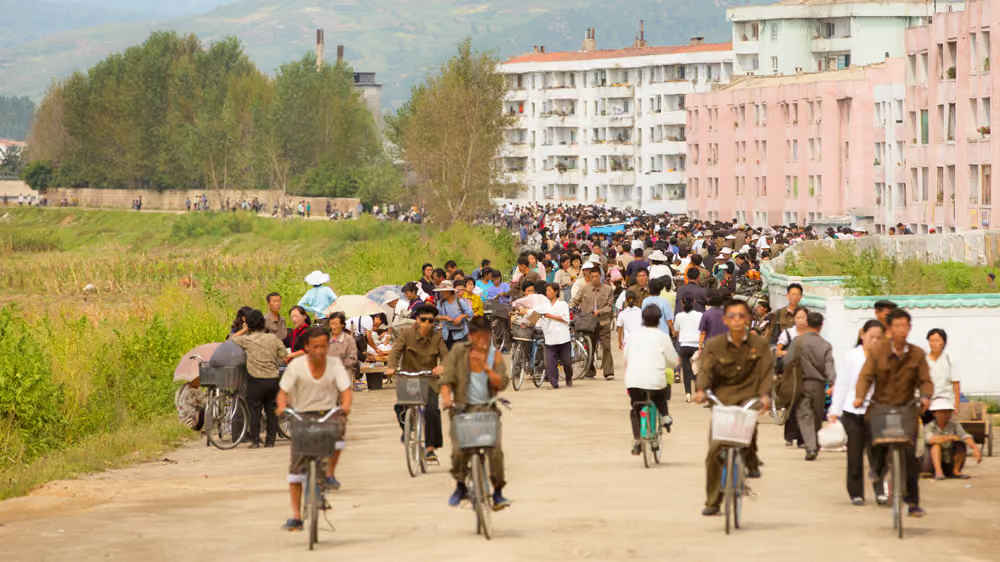
When I think about my past, I often feel a great sense of loss and sorrow for the people I left behind in North Korea. As a PhD student studying North Korean economics here in South Korea, I feel a strong desire to use my research to help improve the lives of North Korean people. In many ways, helping those I left behind also gives meaning to my own journey.
Whenever I watch the news or read academic papers on North Korea, I feel saddened by the way North Korean people are discussed and represented. Over time, I have come to believe that the way we analyze North Korea needs to change.
I believe there is a fundamental limitation in existing research on the North Korean economy, as much of it has traditional socialist planned economy analysis. Earlier studies have suggested that North Korea would either collapse or undergo a system transition as other socialist countries have done. However, after the breakdown of the Public Distribution System (PDS) in the mid-1990s and the emergence of the shadow economy (including through the Jangmadang—illegal markets), these approaches began to reveal their limitations.
As a result, the North Korean economy came to be understood not as a simple planned economy, but as a mixed economy in which state control and market activities coexist. However, these studies do not sufficiently explain why the North Korean regime allows marketization to persist at a certain level instead of completely suppressing it.
In order to explain the interaction between the government and ordinary North Korean citizens, who are the primary actors in Jangmadang activities, I divide the North Korean system into three groups: the regime, the elites, and ordinary citizens.
In particular, elites are important economic actors because they function as intermediaries between the regime and the people. My argument is that this phenomenon can be better understood by analyzing how these three groups strategically interact with one another.
These three groups pursue their interests in different ways, and their goals also differ significantly. The leadership wants to continue dynastic rule and ensure stable succession, the elite seek to secure their positions and avoid political risks such as purges, and ordinary citizens primarily seek survival and improved living conditions.
The interests of these three groups sometimes conflict with one another and sometimes align. In my opinion, these three groups in North Korea are currently remaining in a state of equilibrium.
This equilibrium means that these three groups can achieve their maximum interests under the current conditions in North Korea. Precisely because of this equilibrium, North Korea has been able to maintain both regime stability and limited marketization simultaneously.
That is why I believe we must identify what kind of shocks could cause this equilibrium to collapse. If such a change were to occur, it could become a new turning point for North Korea.
A new turning point for North Korea could lead the country toward a new political and economic order. The important thing is that we must identify what kinds of shocks could trigger such a transformation.
I hope for a North Korea that has changed—a place where its people can live freely. For me, North Korea is not just a state; it is my hometown, where I was born and raised, and where my family still lives. This is precisely why I am committed to a different approach to the North Korean issue—because my only goal is to see genuine change in North Korea, and I truly want to help bring about that change.
I want my article to inspire you to see something different the next time you watch the news or media coverage about North Korea. The next time you come across a piece of media about North Korea, I hope you take a moment to think about the real North Korean people. And perhaps you may also reflect on this article and consider what kinds of shocks could transform the current equilibrium of North Korea.
I hope you will join me on this journey.
–
HyeGyeong is a participant of the LiNK English Language Program (LELP), which serves to not only help North Korean defectors build confidence and skills in English, but develop their capacity as advocates for this issue. To that end, we partnered with select LELP “columnists” to write and polish personal essays through multiple rounds of external feedback and revision. Our goal is to have more North Koreans share their stories directly and lead efforts to change the narrative.
We believe the North Korean people can achieve their liberty in our lifetime.
Opportunities like LELP invest in the people building that future now. Help more North Koreans find their voice, reach their goals, and lead change on this issue.
Give Today
A North Korean Refugee’s Journey - Pursuit of the Freedom to Learn
By Yukyung Lim
Yukyung is a participant of LiNK’s Intensive English Program (LIEP), designed to build the capacity of North Korean English speakers at the intermediate level. In partnership with the British Council, LIEP aims to cultivate participants’ communication and critical thinking skills in English. LIEP is complementary to our broader LiNK English Language Program (LELP), which supports speakers of all proficiency levels.
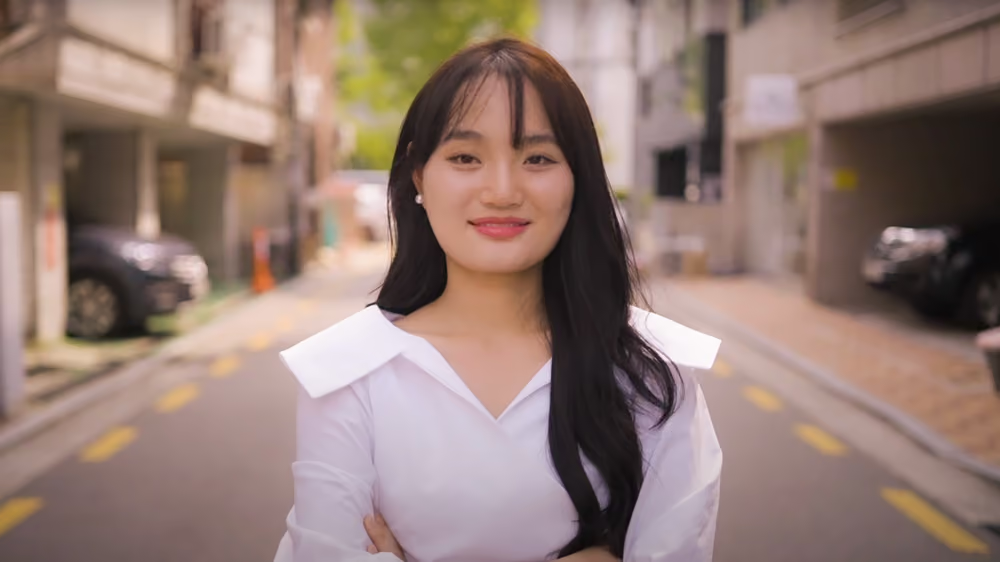
I was born in North Korea—a place where identities are imposed, voices are silenced, and dreams are tightly confined. There, schooling is not a pathway to opportunity but a means of indoctrination, designed to enforce obedience and suppress individuality. But thanks to my mother’s courage, I never had to undergo that system. She made the bold decision to keep me out of school in North Korea. At age eight, I escaped to China to reunite with her, beginning a journey that would define not only my identity but also my deep, lifelong yearning to learn.
In China, my mother obtained a false identity for me so I could enroll in school. That first day in a rural classroom marked the beginning of a different kind of life. I was behind, anxious, and constantly aware of our fragile situation.
For the first time, however, I was learning not to obey—but to think.
A year later, we moved to Beijing. There, I stepped into a world I had never imagined—one of academic rigor, intellectual freedom, and cultural diversity. It was in that environment that I first witnessed how learning can transform a person. Each lesson, each classroom conversation, opened doors not only to knowledge but also to self expression, confidence, and hope.
One winter afternoon in 2010, I was on my way to the bookstore, backpack heavy on my shoulders. Beijing was bleak and cold that year. Snowflakes fell softly, only to be crushed by cars and vanish into the grime of the streets. That scene reflected my life: I bore a name I couldn’t speak aloud, fears I couldn’t share, and a fragile existence that felt quietly lonely.
Inside the bookstore, warmth greeted me. I wandered through the aisles, searching for a quiet corner to rest. Then, I saw it—a book with a black-and-white cover, its portrait etched in solemn ink. The man’s composed expression exuded a power I longed for. I picked it up, almost unconsciously.
“I Have a Dream.”
“I have a dream that one day... people will not be judged by the color of their skin but by the content of their character.”
“This is the time to make real the promises of democracy.”
“We will not be satisfied until justice rolls down like waters and righteousness like a mighty stream.”
These weren’t just words. They were light, seeping through a crack I hadn’t known existed. In a world that had taught me to stay small and silent, they spoke to a part of me I had hidden away. For the first time, I felt truly seen—not for where I was from or what I looked like, but for my thoughts, my voice, and the quiet strength I carried within.
Later, after arriving in South Korea, I faced new challenges. Though I had returned to my cultural roots, I felt out of place. I was older than my classmates, unfamiliar with many social norms, and unsure of how to fit in. But with time, I began to build friendships and navigate this new society. Again, learning was central—it provided not just academic skills but also the social space to grow and belong.
During university, I studied abroad in Texas. It was my first experience in a Western classroom. I was struck by the openness, the individuality, and the value placed on diverse opinions. Being among students from different backgrounds showed me how perspectives can differ—and how that difference enriches everyone.
Wherever I was—in China, Korea, or the United States—the classroom was where I grew the most. It was where I stepped outside my comfort zone, gained confidence, and slowly came to understand who I was becoming.
Across all these countries, I’ve developed not just a global perspective but a deep appreciation for the transformative power of learning. In each setting, the classroom became both a battlefield and a sanctuary. I struggled, but I also discovered. I learned new languages, absorbed new worldviews, and came to realize that I was more than a refugee or survivor. I was a thinker, a student, and a human being with agency.
And then I understood something deeper: My story is rare—but it shouldn’t be. There are still millions of children in North Korea growing up without the right to question, to dream, or to imagine a world beyond their borders. They deserve more than silence or sympathy. They deserve the same chance I had—to envision a different future and be equipped to pursue it.
That’s why I’m sharing my story through Liberty in North Korea. Because stories hold power. They build bridges, shatter stereotypes, and create connections.
North Korean people are not just victims. They are potential scholars, leaders, creators, and changemakers—if only they are given the freedom to grow.
My dream is to one day build a global school for children who, like me, come from hardship but brim with promise. I want to help others discover the same sense of identity and possibility that learning gave me. Until then, I will continue to advocate, teach, and connect.
If you’re reading this, I hope you’ll join me. Learn more. Speak up. Share stories. Support organizations like LiNK that are fighting to empower North Korean people with freedom, dignity, and opportunity.
Because when you invest in a child’s education, you’re not only changing one life—you’re challenging an entire system and planting seeds for a freer world.
Opportunities like LiNK’s Intensive English Program (LIEP) are helping North Koreans succeed in resettlement, reach their goals, and lead change on this issue. Your support can help us continue to make an impact in the lives of North Korean refugees.










