
The Most Dangerous Contraband in North Korea Isn’t a Weapon. It’s a Wish.
By: Jihyun Kang
Growing up in North Korea, Jihyun took inspiration from the smuggled South Korean dramas she watched to create her own unique clothing. After reaching freedom in 2010, she has continued to pursue her interests in fashion and culture as a catalyst for change. She runs several business ventures, practices fine art under the name “Da Gyeol,” and works with the Ministry of Unification as an advisor. She’s pursuing her Masters in Entrepreneurship, Dept. of Future Science & Technology Business, at Korea University.
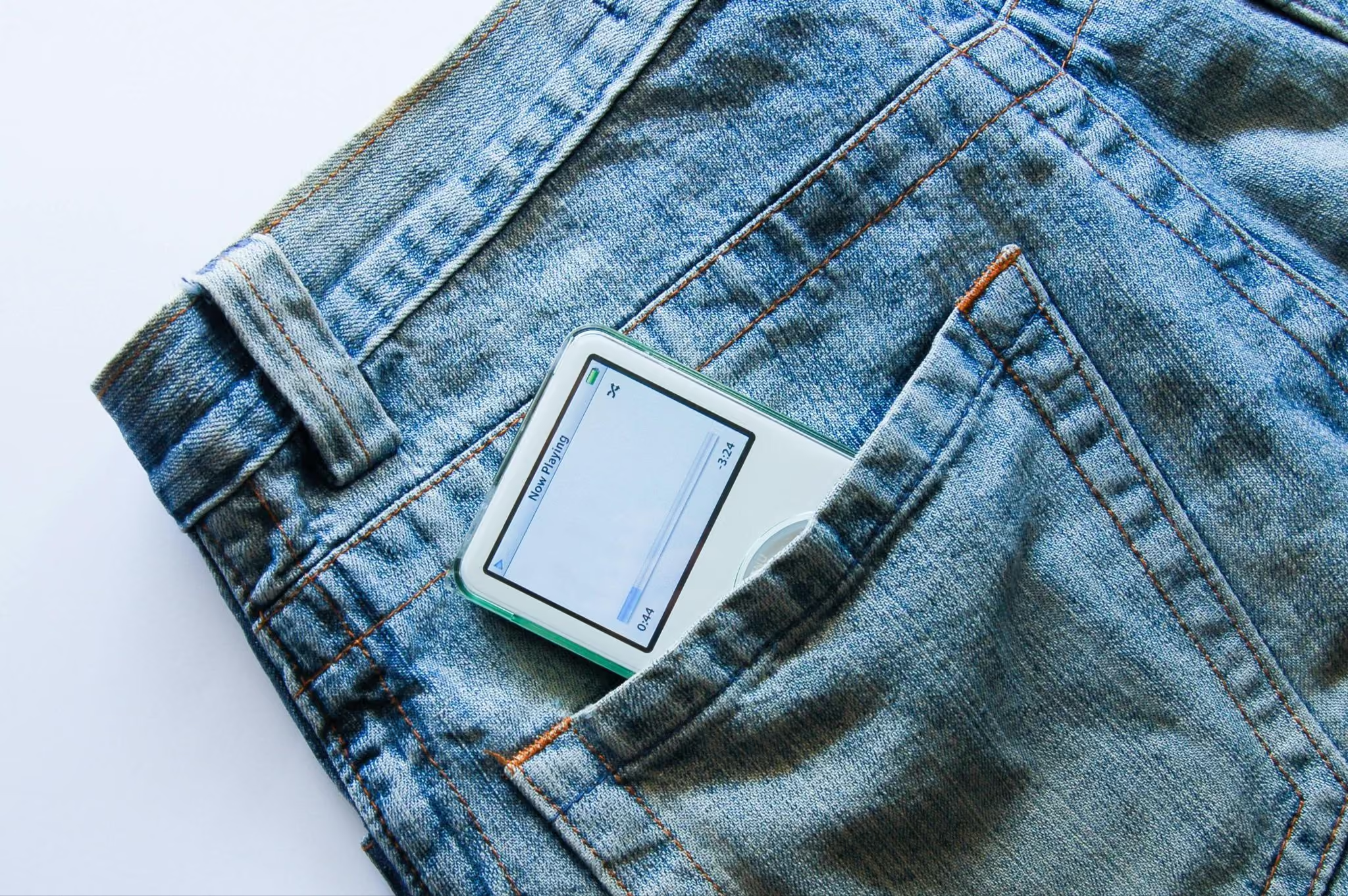
I grew up in North Korea, and at fifteen, I encountered a Westerner for the first time at the top of Mount Paektu. He stood over 190 centimeters tall with a thick beard, wearing ripped jeans and a frayed T-shirt. In North Korea, worn-out clothing was a symbol of deprivation. Yet my father whispered, "He is wearing that for style." With that single remark, the worldview I had been taught, began, the first time, to crack. And I thought: I want to dress like that, too.
Fashion is more than clothing. It is the moment when individual desire moves faster than collective command. People follow taste before ideology, and express themselves through what they wear long before any political declaration.
A state can enforce a dress code, but it cannot manufacture desire. That is why North Korea's fear of blue jeans was not irrational—it was the regime recognizing, however dimly, that something it could not control was already growing.
Clayton Christensen, a professor at Harvard Business School, argued that transformation always begins at the margins—in forms so crude and insignificant that those in power dismiss them entirely. Christensen built his theory around corporations, but the logic applies to any system that holds a monopoly over its people, including a state. North Korea's regime was so focused on maintaining ideological control at the centre that it ignored what was happening at the bottom.
That bottom was the jangmadang—the spontaneous, bottom-up market ecosystem created by ordinary people to survive after the collapse of North Korea's state-led distribution system. When that system imploded during the Arduous March—a famine in the mid-1990s that killed hundreds of thousands—people built informal markets out of sheer necessity: not revolution, not ideology, but survival. Yet by 2018, a CSIS study found 436 officially recognized markets operating across the country. What began as a desperate improvisation had quietly become the infrastructure keeping North Koreans alive.
These markets did not merely sell food. They became conduits for Chinese clothing, USB drives loaded with South Korean dramas, and glimpses of a world no one had taught them existed. When a system ignores what people actually want, the market finds the gap.
The act of choosing—what to eat, what to wear, what to watch—may seem trivial. But a person who has tasted choice cannot fully return to obedience.
The jangmadang was the first place where North Koreans learned they could survive without the state. That desire did not stay underground—it surfaced. People began wearing jeans, dyeing their hair, and pulling on T-shirts printed with foreign letters. The regime could no longer ignore it. Authorities branded jeans and Western fashion as 'anti-socialist infiltrations' and deployed street patrols. Teenagers caught in these sweeps were sent to re-education camps; in severe cases, their names and home addresses were read aloud on state broadcasts as public shaming (Radio Free Asia).
In 2024, state-run Korean Central Television went so far as to blur the jeans worn by British TV presenter Alan Titchmarsh during a broadcast. The ruling party's official newspaper, the Rodong Sinmun, warned that a country could 'become vulnerable and eventually collapse like a damp wall' if it failed to preserve its own way of life (Newsweek, May 2021).
Regulations cannot extinguish human desire; they only raise the price of the forbidden. This is the inflection point Christensen identified: by the time an incumbent recognizes the threat, it is already too late.
To date, more than 34,000 North Koreans have resettled in South Korea (South Korean Ministry of Unification, 2024). At the start of each of those journeys, there was something like my pair of jeans—not ideology, but desire; not a declaration, but a taste; not revolution, but the market.
No government in history has ever successfully suppressed the human impulse to trade, to choose, to want more. Not the Soviet Union. Not Cuba. Not Mao's China. North Korea will not be the exception.
–
Jihyun is a participant of the LiNK English Language Program (LELP), which serves to not only help North Korean defectors build confidence and skills in English, but develop their capacity as advocates for this issue. To that end, we partnered with select LELP “columnists” to write and polish personal essays through multiple rounds of external feedback and revision. Our goal is to have more North Koreans share their stories directly and lead efforts to change the narrative.
We believe the North Korean people can achieve their liberty in our lifetime.
Opportunities like LELP invest in the people building that future now. Help more North Koreans find their voice, reach their goals, and lead change on this issue.
Give Today
North Korean Fellows in the United States: Meet the Class of 2025
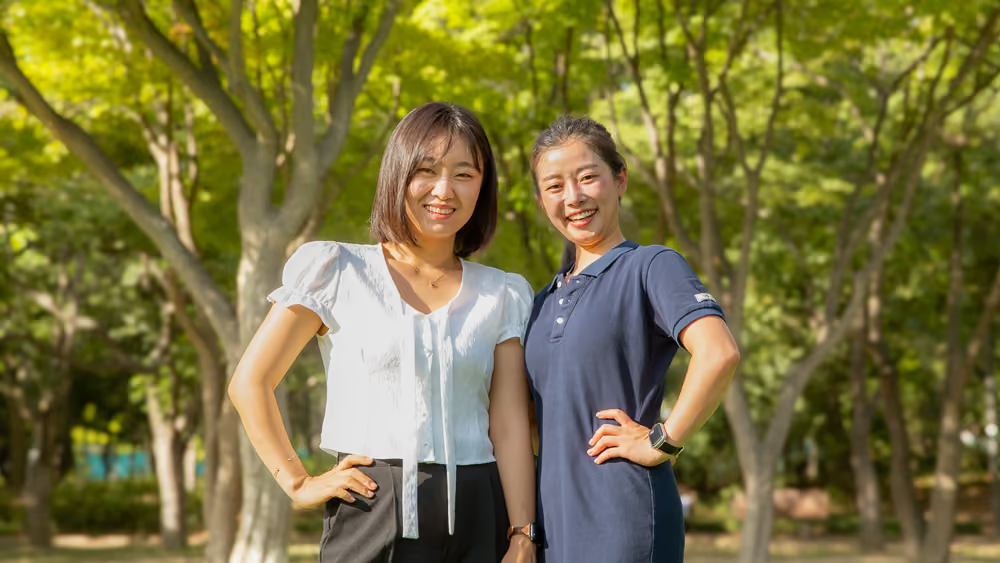
Please join us in welcoming Hannah and Rose, LiNK’s 2025 Advocacy Fellows!
The Advocacy Fellows program partners with young North Korean defectors to build their skills as effective leaders, storytellers, and agents of change for this issue. Hannah and Rose spent the last month training and preparing with our team in South Korea, and will now be traveling across the US to share their stories!
Join us at a Fellows speaking event near you!
Dallas, TX
September 9th, 6pm
Southern Methodist University | Dallas Hall Room 306 (McCord Auditorium)
3225 University Blvd, Dallas TX 75205
RSVP Here
Guest parking information here
Waco, TX
September 11th, 6pm
Baylor University, Foster Campus | Room 240
1621 S 3rd St, Waco, TX 76706
RSVP Here
Parking: 1521 S Fourth St. Waco,TX 76706 (Google maps or Apple Maps)
Madison, WI
September 16th, 12pm
UW-Madison | Lubar Commons (Room 7200)
975 Bascom Mall, Madison, WI 53706
RSVP here
Evanston, IL
September 20th, 5pm
Northwestern University | Harris Hall 107
1881 Sheridan Rd, Evanston, IL 60201
RSVP Here
Palo Alto, CA
September 28th, 1:20pm
True North Church
655 Arastradero Road, Palo Alto, CA 94306
RSVP Here
Berkeley, CA
September 29th, 6pm
UC Berkeley | Stephens Lounge at the MLK Student Union
2495 Bancroft Way, Berkeley, CA 94720
Parking: Lower Sproul Garage
RSVP Here
Washington, D.C.
October 8th, 1pm ET
The Stimson Center
1211 Connecticut Avenue Northwest Washington, DC 20036
RSVP Here
*Online livestream also available: RSVP Here
Washington, D.C
October 9th, 10:30am
ET Hudson Institute
1201 Pennsylvania Ave N.W. Suite 400 Washington, DC 20004
RSVP Here
Philadelphia, PA
October 13th, 5:30pm
University of Pennsylvania
3401 Walnut Street, Philadelphia, PA 19104
RSVP Here
New York, NY
October 16th, 2025, 12 PM
The Korea Society
350 Madison Avenue, 24th Floor
New York, NY 10017
RSVP here
Los Angeles, CA
October 21st, 7:30pm
UCLA
Haines Hall Room A2 Portola Plaza, Los Angeles, CA 90095
Parking available in UCLA Parking Structure 2
RSVP here
Additional details and timely updates will be sent to RSVP’ed guests via email.
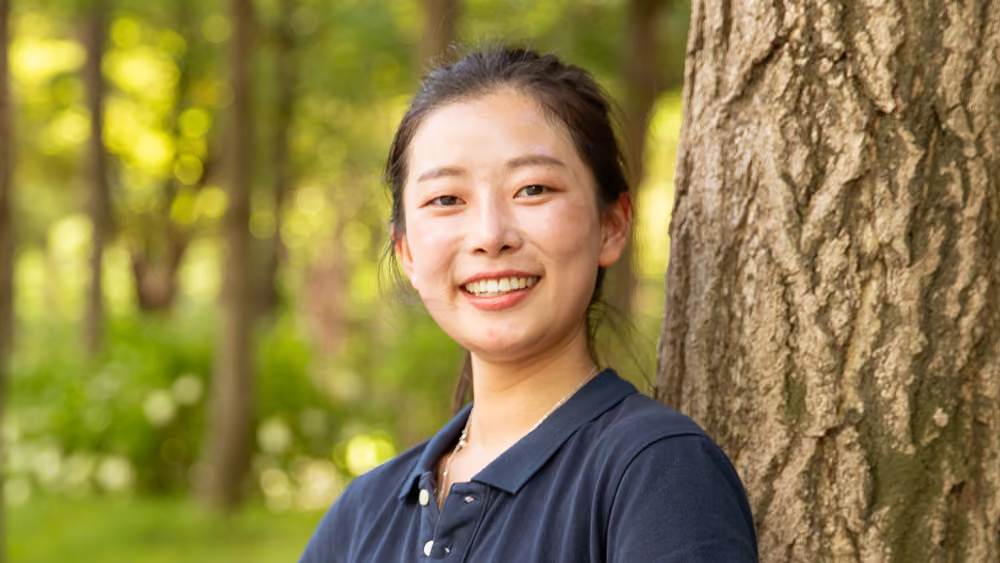
Hannah is a 4th year student at Hongik University studying Electrical and Electronic Engineering. While participating in LiNK’s Changemaker Scholarship Program, she worked on developing devices and strategies that increase information access for people inside North Korea. Her goal as an Advocacy Fellow is to grow as a leader and communicator, and facilitate more collaborative work on this issue.
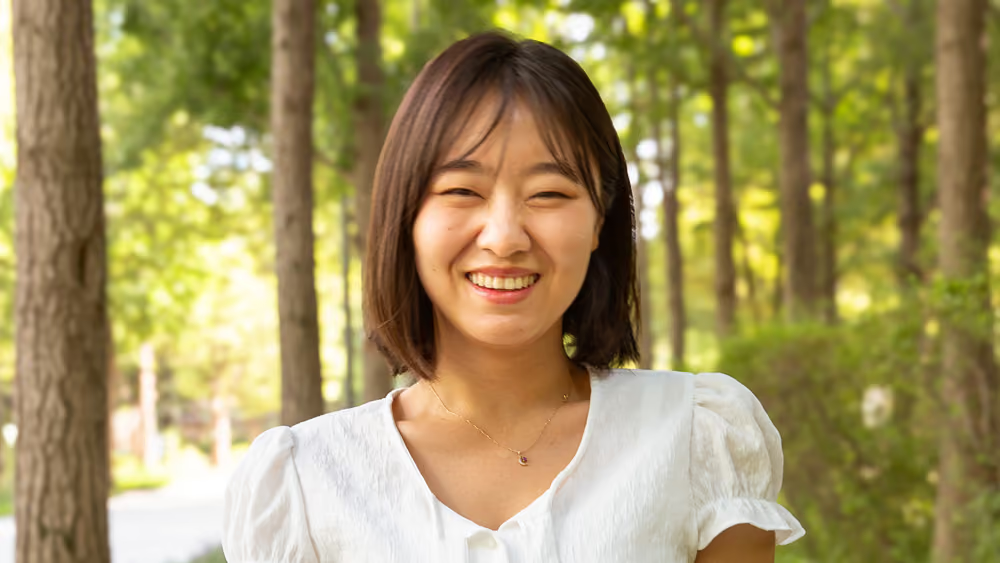
Rose graduated from Hongik University’s Department of Architecture. For her final project, she designed a memorial to honor North Korean human rights and provide comfort to defectors who had to leave their homeland. She drew inspiration from the Holocaust and 9/11 Memorials in the US, and was deeply moved by how such spaces contribute to healing and progress. As an Advocacy Fellow, Rose hopes to continue finding her identity and increase interest in this issue.










