
Yoon Ha's Story: Part 2 - Life in China

This is the second part of a three-part story. Read part one about the hardships Yoon Ha experienced growing up in North Korea that led her to escape. Part three follows this part with her experience resettling in South Korea.
The couple who helped me escape into China brought me to a house that same night after we crossed the river. There they told me about my options. They said I could work in a restaurant somewhere in China. However, there would be a high risk that I would be caught by the Chinese police and get sent back to North Korea. I already knew that if you get sent back to North Korea from China, you could be severely punished by the North Korean regime.
They said there was another way, which would be safer; I could "marry" a Chinese man. They told me my Chinese husband would protect me from getting caught by the Chinese police. So it seemed that this was the best choice I could make. I had already come to China and I didn’t want to go back to North Korea. I was prepared to do anything to have a better life, so I told the couple that I would live with a Chinese man.
The next morning the couple took me to a car and we started driving.
In the car, I started getting scared. The only thing I knew was that I was going to live with a Chinese man I had never met, and I was just hoping that my life would somehow get better through the marriage. After driving for a while, we arrived in a small city in China. There I met some Chinese people who turned out to be family members of the man I would marry.
I saw one of them give money to the couple who had brought me there. It was then that I realized that I had been sold.

A part of me still felt I could do anything to have a better life. But it didn’t feel good to be sold like an object. Even to this day, there are so many North Korean women being trafficked like I was. This kind of trafficking is now an industry.
I also felt selfish for leaving my mother and sister without letting them know. I came all this way so that I could have a better life, but I missed them a lot. I didn’t know what would happen next or how the Chinese man would treat me. At that point, I wanted to run away, but it was too late and there was nowhere to go. It was a small town in the country and I didn’t know anything, including the Chinese language.
Without having a proper wedding, I started living with the Chinese man - I don’t even want to call him my husband. It was frustrating not knowing any Chinese. And since I was sold into the marriage, I didn’t love the man. So it was really hard for me to live with him.
Despite all of this, I would eventually have my first daughter with him.
He and his family farmed for a living and were very poor. His family didn’t treat me well. They made me do all sorts of hard work on the farm and they would say bad things about me. Sometimes I even got hit. I wasn’t familiar with the area and couldn’t speak the language very well for the first couple of years. And there was always the danger of getting caught by the Chinese police and sent back to North Korea.
I cried a lot whenever I was by myself. I knew I had to keep enduring it for my daughter but it was so tough.

I started hearing from some people around me that I could live safely and freely if I could make it to South Korea. I didn’t want to leave my daughter, but I couldn’t keep living this life without freedom. So I decided to run away, hoping that I could come back for my daughter later.
I soon discovered that it would cost me a lot of money to find people who could take me to South Korea. I had no money, so I ended up getting sold to another Chinese man in order to survive.
Living with the second Chinese man was even worse than with the first one. I still had to do a lot of hard farming work and he was always watching me. He was suspicious that I was going to try to run away. When he went to work he brought me to his workplace so he could still watch me. And he was not kind to me. Whenever I got sick, he didn’t care.
I felt so unloved and suppressed.
Soon, I was pregnant with my second daughter. All the while, my desire to go to South Korea kept growing. I thought about giving up on my unborn daughter, knowing that I couldn’t be a good mother to her while living like this in China. And I knew it would be even harder for me to leave after I gave birth to the baby. But I didn’t want to leave another child of mine for my own freedom.

After hearing from some people that I could raise my child with support from the government in South Korea, I started having hope. I dreamt about living there with my baby. So I looked for opportunities to run away from the second Chinese man, even though he was always watching me. At some point, I met another North Korean woman who lived in my town and who had also been sold into a marriage. She said she could connect me to people in a different city who could help me go to South Korea.
When I was eight months pregnant and my stomach was so big, the Chinese man didn’t watch me as much as he had before. Maybe he thought my body was too heavy to run away. So one day I left home, telling him that I was going to my friend’s house. But actually, I was going to another city to meet people who would connect me to LiNK’s network.
When I was about to leave the town, however, I got caught by the Chinese man. He made me sit behind him on his motorcycle and was taking me back to his house. Riding on the back of the motorcycle, my hat got blown off my head by the wind. I asked him to stop so I could pick it up. It was my favorite hat. He said, “No, we aren’t going to stop. Forget about the hat.”
At that moment, my whole heart and body were telling me, “Do not give up on what you deserve. You deserve to have a simple hat and you deserve to live in freedom like a human being.”

I don’t know how I did it but I jumped off the motorcycle while it was moving. Luckily he wasn’t going too fast and I landed on my back so the baby didn’t get hurt, and I was okay other than scratching my forehead while rolling on the ground.
I got up and started walking toward where the hat fell. The man asked me where I was going and I told him that I was going to get my hat. His motorcycle had lost balance and fallen after I jumped. He didn’t even ask how I was as he started to inspect it for damage. I realized this was my opportunity to run away again. So I grabbed my hat and started running up into the nearby mountains.
I kept going up and up until I was near the top where I could see the road, the man, and his motorcycle. I hid there for a few hours, scared of getting caught by him again. I actually saw him driving around to find me. So I climbed further up and over the other side of the mountain.
Being eight months pregnant, my body was very heavy. But I had to keep moving to get away from the man. I made it over the mountain.
I started heading to the city by taking different vehicles. One time I got on a truck that was transporting dogs. Since all the space was taken by the dogs, I had to sit on one of the guys’ laps in the front seat.
Finally, after some long bus rides that made me feel sick, I connected with LiNK’s network.
Continue reading with Part 3.
North Korean Women's Football Team Arrives in Suwon: Propaganda vs Real People
⏱️ 30-Second Summary
- Inter-Korean Women’s Soccer: The AWCL semi-final between Suwon FC Women and North Korea's Naegohyang Women's Football Club has been confirmed for May 20th at Suwon Sports Complex. This visit by a North Korean sports delegation will be the first of its kind in nearly eight years.
- High-Stakes: In North Korea, social advancement is nearly impossible if one’s “songbun” (political status) is unfavorable. The realm of sports is a rare exception. A win in an international competition secures a jump in social standing. On the other hand, the cost of failure is just as high.
- The Women Behind the Uniform: Two documentaries by Director Brigitte Weich, Hana, Dul, Sed and Ned, Tassot, Yossot offer a glimpse of the passion, friendship, and subsequent lives of North Korean athletes.
The First North Korean Sports Delegation to Visit South Korea in Eight Years
On May 20th, Pyongyang-based Naegohyang Women’s FC and South Korea’s Suwon FC Women will be facing off in the semi-finals of the AFC Women’s Champions League. The match will take place in South Korea at the Suwon Sports Complex. This visit by a North Korean sports delegation will be the first of its kind in nearly eight years. The last time a North Korean women’s football team competed on southern soil was at the 2014 Incheon Asian Games.
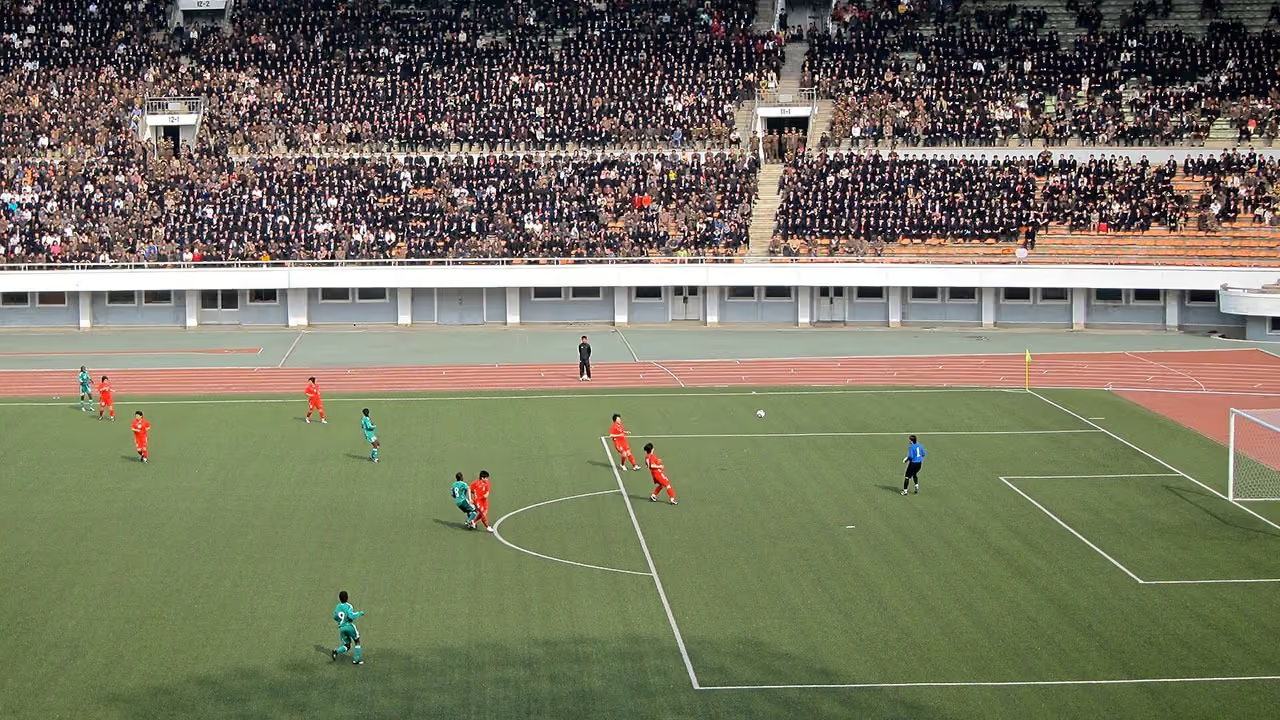
The North Korean women’s football team has consistently demonstrated world-class strength. Expectations for their upcoming match are high, naturally leading to questions about the individuals representing the world’s most closed country: How did North Korean women’s football reach this level? Under what conditions are these athletes playing? And how will their lives continue after the match ends?
World-Class Athleticism: North Korean Women's National Football Team
As of April 21, 2026, the North Korean women's national football team is 11th in the FIFA rankings, placing it in the top tier globally. Comparatively, South Korea is ranked 19th. The North Korean team has maintained its status with multiple wings in international tournaments, including the U-17 and U-20 Women’s World Cups.
Naegohyang Women's Football Club is the reigning champion of North Korea's top-tier women's football league, celebrating its 10th anniversary in 2022. In the quarterfinals of the AFC Women’s Champions League, they defeated Vietnam's Ho Chi Minh City Women’s FC to secure their ticket to Suwon.
This strong performance is not limited to just the Naegohyang club. North Korean women’s football has also won the U-17 and U-20 Women’s World Cups multiple times. At the 2025 U-17 tournament held in Morocco, the team once again claimed the title by defeating the Netherlands 3-0.
From Elementary School to Pyongyang
In an interview with Kyunghyang Newspaper, Professor Hyun In-ae of Ewha Women’s University attributed the strength of North Korean women’s soccer “not the the popularization of athletic activities, but rather to state-led selection and development.”
The development of athletes in North Korea begins at a very young age. North Korean authorities reportedly "bring football prodigies from across the country to Pyongyang starting in elementary school and train them systematically." Recognizing that performance in international competitions contributes to the national image, the state provides support ranging from European-style training systems to even overseas training camps.
Medals, Apartments, and Coal Mines: A System Where Winning and Losing Determine One’s Life
In North Korea, social advancement is nearly impossible if one’s “songbun” (political status) is unfavorable. The realm of sports is a rare exception. Winning a medal at an international competition secures a jump in social standing.
For competitions like the Asian Games, individuals who bring home a medal are awarded the title of "Merited Athlete.” For events at the level of the Olympics or World Championships, the “People’s Athlete” honor is bestowed. Decorated athletes with many medals may receive the title of “Labor Hero,” and potentially even the highest distinction of all: "Hero of the Republic." On top of such recognition, unique comforts like athletic pensions, luxury apartments, and imported cars may be rewarded.
On the other hand, the cost of failure is just as high. After losing to a South Korean competitor at the judo finals of the 1990 Beijing Asia Games, Ri Chang-su, a North Korean “Merited Athlete" was sent to labor in a coal mine. He testified as follows: "I truly lived my life working hard for my country, yet simply because I took second place, they sent me to a coal mine and wouldn't even let me quit the sport." After a loss in the 2010 World Cup in South Africa, the entire North Korean men’s national team was summoned to Pyongyang and subjected to a six-hour public criticism session in front of 400 people.
North Korean Sports as a Tool for Propaganda
When it comes to understanding North Korean sports, glory and punishment are inextricably bound together because it serves as a form of propaganda. The regime sees it as a tool to "promote the regime internationally and publicize its achievements domestically."
Following the North Korean women's national football team's victory at the 2024 U-20 tournament, Sin Yong-chol, Chairman of the Football Association under the Ministry of Physical Culture and Sports, remarked in Rodong Newspaper that "sports are precisely a war without the sound of gunfire waged against enemies in peacetime."
For the North Korean athletes coming to compete in Suwon on May 20th, the weight resting on their shoulders is far more than just the outcome of the match.
The Lives of North Korean Women Athletes: Documentary Hana, Dul, Sed
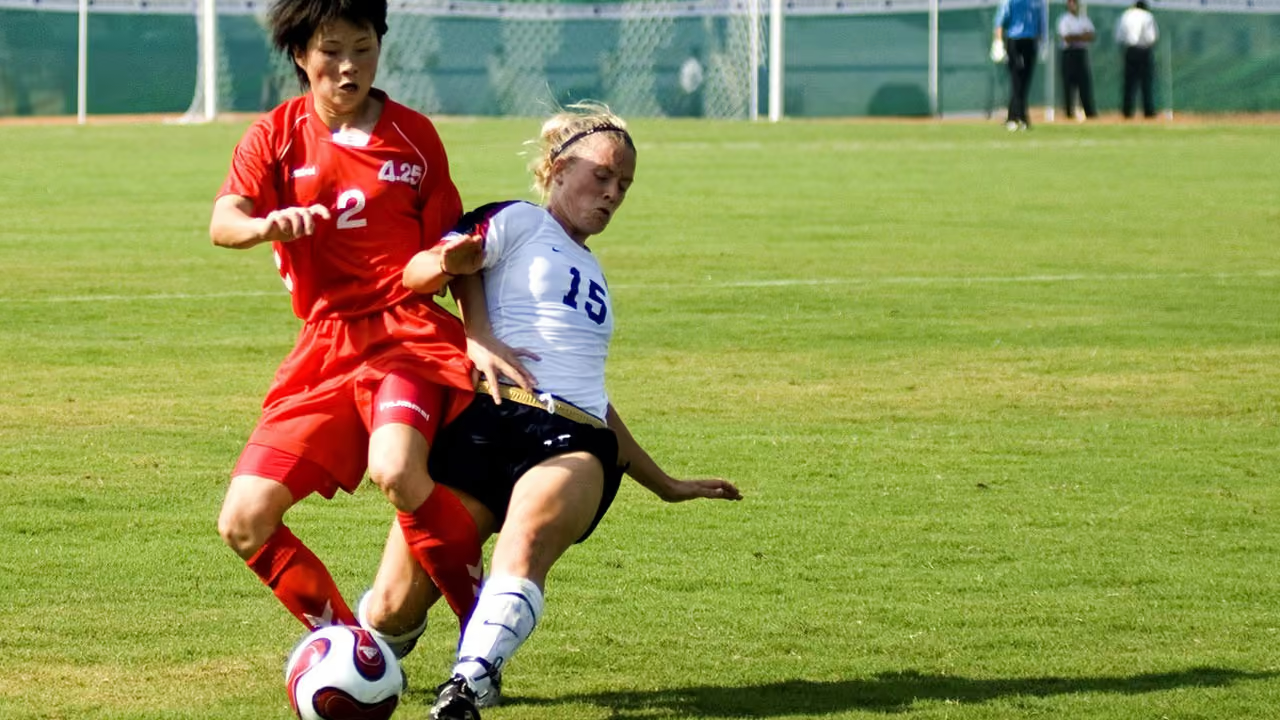
Despite the circumstances under which they play, North Korean athletes cannot be defined solely by the role assigned to them by the regime. Beyond the language of propaganda, there are ordinary people who genuinely love football.
In 2009, Austrian filmmakers Brigitte Weich and Karin Macher released Hana, Dul, Sed (One, Two, Thee), a documentary that closely chronicles the lives of four athletes from the North Korean women's national team: Ri Jong-hui, Ra Mi-ae, Jin Byeol-hui, and Ri Hyang-ok. These women played a pivotal role in elevating North Korean women’s football to world-class status. However, after their elimination in the qualifiers for the Athens Olympics, the careers of the four athletes came to a sudden end.
The film’s protagonists are not the North Korean regime, but the players themselves. Towards the end of the film, Ra Mi-ae, known for her lively personality, and Ri Hyang-ok, known as “the beauty of the team,” reminisce over the friendship they forged during their training days. They mention that since being dismissed from the team, they rarely get to see each other anymore.
Attempting to articulate the allure of soccer, Ri Hyang-ok chokes up, “The moment I stepped into the stadium, my heart opened wide—it felt as though I could embrace the whole world."
Through rare personal accounts, Hana, Dul, Sed offers a humanizing perspective of the athletes who take the field on behalf of North Korea. These individuals are not just tools of the regime, but people driven by the love of the game, just like the members of the teams they face.
The Universal Experience of Women
Five years after Hana, Dul, Sed, Director Weich returned to Pyongyang to meet with the same four athletes featured in her original documentary. She shares the story of how their lives had evolved in the sequel, Ned, Tassot, Yossot (Four, Five Six): The Legends of North Korean Women’s Football (2023).
Even after retirement, the former national football team players have remained close to the sport. They have each established themselves as FIFA-affiliated referees, coaches, or mentors, dedicated to nurturing the next generation of athletes.
The documentary also captures the muti-dimensional nature of these women’s lives. Lee Jung-hee, former goalkeeper of the team, is shown juggling life as a student and as a mother of a young daughter. Anxieties surrounding marriage, pregnancy, childbirth, and raising a family—all while struggling to sustain one’s career—are common themes.
While telling the unique stories of these women in North Korea, the film also conveys a deeper truth, that their lives are not so different from those of women in any other country.
What’s Next: Potential Rematch at the 2027 Brazil World Cup
The AWCL semi-final on May 20th will be the first time North and South Korean athletes face each other on South Korean soil in eight years. Both teams have already secured their spots in the 2027 Women’s World Cup finals. South Korea advanced to the semifinals of the 2026 Asian Cup, while North Korea secured a ticket to Brazil by defeating Taiwan 4–0 in the March playoffs. Depending on the results of the group stage draw, the possibility of a national team rematch remains open.
Beyond the Score, the Right of Twenty-Two Players to Live an Ordinary Day
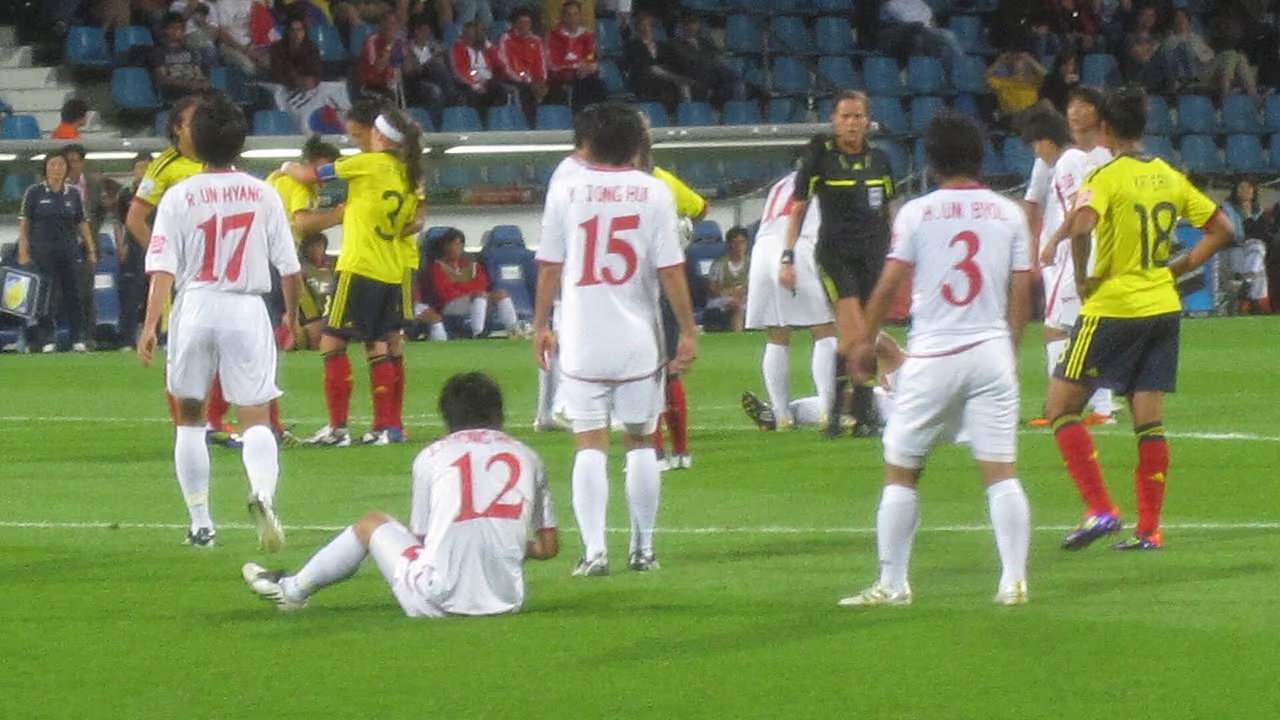
The upcoming match on May 20th is an opportunity for the world to see this issue—typically treated as political—from a more universal perspective: that of women and sports. The North Korean athletes playing that day are more than subjects of a news report or the public faces of a political regime. They are fellow human beings, taking the field with passion and love for the game.
📩 Subscribe to LiNK’s Newsletter
Get North Korean stories and updates on social, technological, and cultural developments inside North Korea that you won’t hear on the news. Join LiNK’s newsletter below today.










